


Last Updated: October 26, 2026
Quick Summary
Smart kitchen appliances deliver genuine value for luxury homes when their connected features match your household’s actual needs, but they cost significantly more upfront, require stable WiFi, and depend on manufacturer software support for long-term functionality.
- Smart appliances add convenience through remote monitoring, automation, and voice control, but cost more than traditional luxury appliances.
- Core cooking and cooling performance is identical between smart and non-smart premium models; the difference is software features on top.
- Before buying, list three connected features you would use weekly; if you cannot name three, a premium non-smart model is the stronger investment.
- Smart appliances require reliable WiFi coverage and integration with a unified platform like Alexa, Google Home, or Apple HomeKit to avoid fragmentation.
- Total cost of ownership over 10 years includes purchase premium, installation upgrades, subscription fees, repairs, and shorter software lifespan than mechanical lifespan.
Table of Contents
- Do Smart Kitchen Appliances Justify the Investment?
- Smart Kitchen Appliances Pros and Cons
- Smart Appliances vs. Traditional Appliances: Where the Real Difference Lies
- Best Smart Appliances for Luxury Kitchens
- Smart Appliance Compatibility: Making Them Work Together
- Total Cost of Ownership: Purchase, Operation, and Repair
- Planning Your Smart Kitchen Remodel with Professional Guidance
- Frequently Asked Questions
Do Smart Kitchen Appliances Justify the Investment?
Smart kitchen appliances represent a significant financial commitment for luxury homes. The question isn’t whether they’re technologically impressive, it’s whether the added cost delivers genuine value that justifies the premium over traditional high-end appliances.
The answer depends on how you use your kitchen and what matters most to you. Smart appliances excel at convenience, remote monitoring, and integration with your home’s connected ecosystem. But they also carry higher upfront costs, require reliable WiFi, and depend on manufacturer software support for features to remain functional over time.
At Crosspoint Contracting, we’ve remodeled kitchens and homes across the Phoenix Valley for 16 years. The real value of smart kitchen appliances lies in matching specific features to your household’s actual needs, not in chasing every connected gadget on the market.
Smart Kitchen Appliances Pros and Cons
Smart appliances offer genuine advantages for the right households. Remote monitoring lets you check if the refrigerator door was left open or preheat the oven from your car. Automated notifications alert you when food is expiring or when the dishwasher cycle completes. Integration with voice assistants adds convenience for hands-free operation during cooking.
The tradeoffs matter. Smart appliances cost significantly more than their traditional counterparts. They depend on WiFi stability, a dead connection means losing features. Software updates are controlled by manufacturers; if they discontinue support, your appliance’s smart functions may stop working. Repairs often require certified technicians familiar with the connected systems, which increases service costs.
| Aspect | Pros | Cons |
|---|---|---|
| Remote Monitoring | Check status from anywhere | Requires stable WiFi connection |
| Automation Features | Save time on routine tasks | Higher upfront purchase price |
| Voice Control Integration | Hands-free convenience | Depends on manufacturer support |
| Energy Tracking | Monitor consumption patterns | Data privacy considerations |
| Predictive Maintenance | Alerts before failure | Repair costs higher than traditional |
For busy families who value remote access and automation, smart appliances deliver real utility. For households that prioritize reliability and lower operating costs, traditional luxury appliances often make more sense.
Smart Appliances vs. Traditional Appliances: Where the Real Difference Lies
The performance gap between smart and non-smart luxury appliances is smaller than most buyers assume. Both categories use premium materials, advanced heating systems, and precision temperature control. A traditional high-end refrigerator preserves food just as effectively as a connected model, and a premium non-smart range can hold temperature as steadily as a connected one. The difference is not cooking quality, it is what the software layer adds on top of that build quality.
A side-by-side comparison makes the trade-off concrete:
| Capability | Premium non-smart model | Smart connected model |
|---|---|---|
| Core cooking and cooling performance | Excellent | Excellent |
| Remote preheat or start | Not available | Available on supported models |
| Status and cycle notifications | None | Push alerts via app |
| Energy monitoring | None | Real-time usage in app |
| Predictive maintenance alerts | None | Available on some models |
| Voice assistant control | None | Works with major ecosystems |
| Repair complexity | Lower; widely available technicians | Higher; certified technicians often required |
| Software dependency | None | Features depend on manufacturer support |
| Expected useful life | 10-15 years mechanical | 10-15 years mechanical, shorter feature life |
Where smart appliances genuinely differ is in convenience and data. You cannot remotely start a traditional oven, but you can with a supported smart one. Traditional dishwashers do not send notifications when the cycle ends; smart models do. A traditional range does not track energy consumption in real time; a smart range does. None of these change how well the appliance cooks or cools, they change how much attention the appliance demands from you.
Usefulness depends heavily on household and cooking habits. A practical decision matrix:
- Frequent cooks get the most from remote preheating, temperature monitoring, and cooking logs. The time savings are real and recur daily.
- Entertainers benefit from remote monitoring during long cooks and from notifications that free them from hovering in the kitchen while guests are present.
- Families gain the most from refrigerator cameras, expiration alerts, and dishwasher cycle notifications, which reduce waste and forgotten tasks.
- Occasional users rarely capture enough recurring value to justify the connectivity premium; a premium non-smart model usually serves them better.
Watch out for the infrastructure prerequisite. Smart appliances require integration with your home’s WiFi network. If your kitchen lacks reliable coverage, smart features become unreliable or unusable. Before committing, confirm your network can support multiple connected devices simultaneously and that your chosen ecosystem, Amazon Alexa, Google Home, or Apple HomeKit, supports the models you are considering.
Before buying, list the three connected features you would use weekly. If you cannot name three, the connectivity premium is unlikely to pay back for your household, and a premium non-smart model is the stronger investment.
Best Smart Appliances for Luxury Kitchens
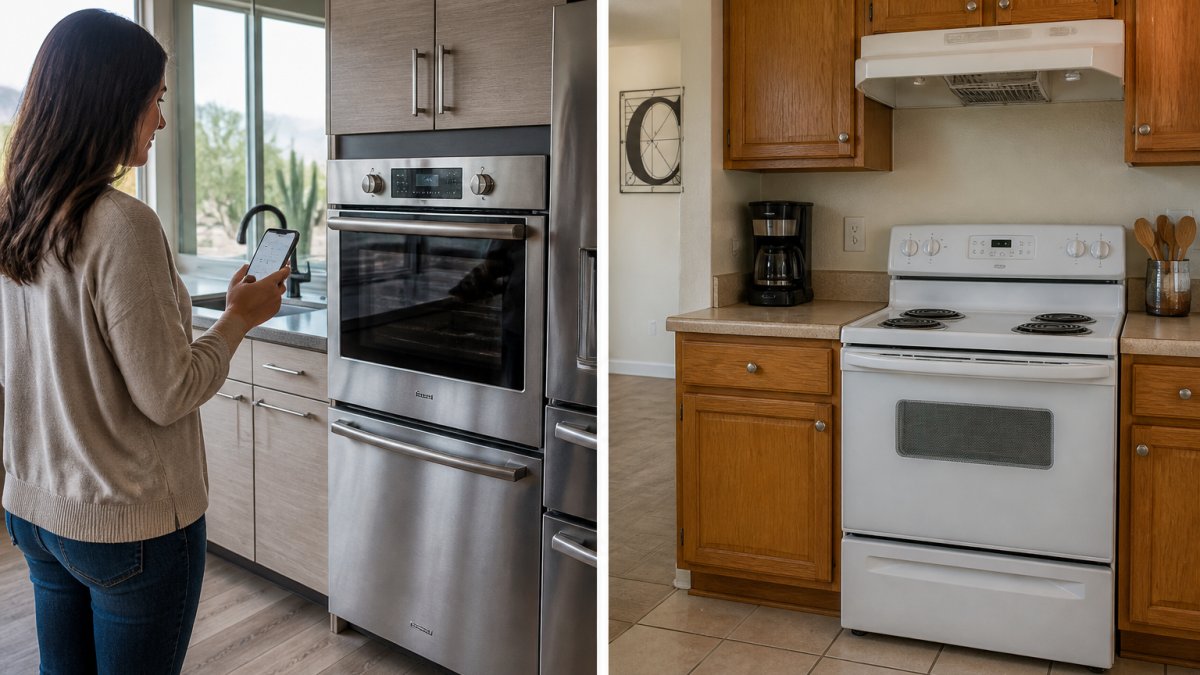
The most practical smart appliances for luxury kitchens fall into three categories: refrigeration, cooking, and dishwashing. Each serves a different purpose and delivers different value depending on your household. Understanding the core functionality of a smart kitchen appliance remains essential for homeowners aiming to integrate these sophisticated systems into their daily culinary routines.
Smart refrigerators with internal cameras let you view contents remotely and receive alerts when food is expiring. This feature works best for larger households or families that shop infrequently. The camera feed requires a stable WiFi connection and cloud storage, which raises privacy considerations worth evaluating.
Smart ranges and ovens offer remote preheating, temperature monitoring, and precise cooking automation. These appeal to households that cook regularly and value convenience. Professional-grade smart ranges from premium manufacturers integrate with voice assistants and provide detailed cooking logs.
Smart dishwashers with cycle notifications and remote start capabilities save time on household management. They’re most useful for busy households where someone might forget to run the dishwasher or retrieve dishes promptly.
Less essential smart appliances include connected beverage coolers, smart trash cans, and WiFi-enabled microwaves. These add cost without delivering measurable time savings or convenience for most households. Before selecting any smart appliance, ask whether you’d actually use the connected features regularly enough to justify the price difference. Review high-end kitchen appliances in Phoenix to compare specific models, reviews, and warranty details.
Smart Appliance Compatibility: Making Them Work Together
Smart appliances work best when they integrate with a unified platform, either a major ecosystem like Amazon Alexa, Google Home, or Apple HomeKit, or through a manufacturer’s proprietary app.
The challenge arises when you mix brands. A smart refrigerator from one manufacturer may not communicate directly with a smart range from another. Each appliance might require its own app, its own WiFi connection, and its own setup process. This fragmentation creates friction that undermines the convenience smart appliances promise.
Before purchasing any smart appliance, verify compatibility with your home’s existing ecosystem. If you use Alexa throughout your home, prioritize appliances that integrate directly with Alexa. If you’ve committed to Google Home, choose brands that support Google’s platform. Mixing ecosystems works but adds complexity and reduces the seamless automation that makes smart kitchens valuable.
Total Cost of Ownership: Purchase, Operation, and Repair
Most comparisons stop at the sticker price. For a luxury home, the honest question is what a smart appliance costs to buy, install, run, maintain, and eventually replace over a defined period. You can also review our detailed breakdown of high-end kitchen costs for the broader remodel budget.
Purchase price. In the luxury tier, connected features typically add a premium over a comparably built non-smart model from the same manufacturer. The premium is usually smallest on refrigeration and largest on cooking appliances, where connectivity is bundled with precision cooking and automation.
Installation. Smart appliances can add installation cost in three places: a dedicated circuit or outlet for a connected range or refrigerator, a stronger WiFi access point or mesh node near the kitchen, and cabinetry or ventilation modifications if the connected model is deeper or requires different clearances. These are project-specific, so get them quoted before you commit to a model rather than after.
Energy and operation. The connected radios and displays draw negligible electricity compared with heating, cooling, and motors. The real operating difference comes from efficiency ratings and usage habits, not from connectivity.
Connectivity costs. Some manufacturers bundle app access and cloud storage for camera feeds with the appliance; others gate premium features behind a subscription. Ask specifically whether remote camera access, cooking logs, or automation recipes require a paid plan, and whether the appliance loses core functions if you decline.
Repair and maintenance. Traditional luxury appliances are generally cheaper to service because independent technicians are widely available and parts stay in stock for years. Smart appliances often require manufacturer-certified technicians for connected components, and a failed control board or WiFi module can cost more than a mechanical repair.
Replacement and software longevity. A common planning assumption is 10-15 years of useful mechanical life, with peak smart functionality in roughly the first 5-7 years. After that, app support may slow, integrations may change, and features may degrade even while the appliance still cooks and cools. The appliance does not become useless, it becomes a premium non-smart appliance, but the connected value you paid for has a shorter shelf life than the hardware.
Compare total cost over a 10-year horizon, not the sticker price. Add the connectivity premium, any installation upgrades, subscription fees, one out-of-warranty repair, and the shorter useful life of the software layer. If the annualized cost still beats the non-smart alternative for the features you will actually use, the investment is defensible.
Confirm in writing whether the manufacturer charges for app features, how long it commits to software updates, and what happens to remote features if the service is discontinued. These answers vary widely by brand and are the single biggest unknown in smart appliance ownership.
Planning Your Smart Kitchen Remodel with Professional Guidance
A smart kitchen remodel requires coordination across design, electrical infrastructure, WiFi networking, and appliance selection. This complexity is why working with an experienced contractor matters.
Your kitchen’s electrical layout must support smart appliances. Learn about luxury kitchen remodel costs in Phoenix to understand pricing, ROI, and budget planning for your project. WiFi coverage must reach every appliance reliably. Cabinetry must accommodate the specific dimensions and ventilation requirements of the smart models you’ve chosen. Gas lines, water supply, and drainage need proper planning around connected fixtures.
At Crosspoint Contracting, we offer a design-build approach. We work directly with the owner, not a rotating cast of project managers.
If you’re ready to move forward with a kitchen remodel, get a free quote from Crosspoint Contracting.
Smart kitchen appliances deliver genuine value for households that will actually use their connected features. The challenge is honest assessment: which features will you use regularly, and which are you paying for without benefiting? Get a free quote from Crosspoint Contracting for your kitchen remodel.
Frequently Asked Questions
Are smart kitchen appliances worth it for most homeowners?
Whether smart kitchen appliances are worth it depends on your cooking habits, budget, and willingness to adopt connected technology. Consider which features you would use and whether they justify the added cost for your household.
What are the main disadvantages of smart kitchen appliances?
Potential considerations include purchase cost, repair costs, dependence on Wi-Fi and software updates, privacy, and compatibility. Check the manufacturer’s information for details about support and features.
Can smart appliances from different brands work together?
Compatibility and available features can vary by appliance and platform. Before purchasing, verify that each appliance supports your chosen smart-home platform and that the features you want, remote monitoring, scheduling, alerts, are available.
How much longer do luxury appliances typically last compared to standard models?
Appliance lifespan and software support vary by model and manufacturer. Check the manufacturer’s information about expected appliance life and how long connected features will be supported.
