


Table of Contents
- Outdoor Kitchen vs Built-In Grill Station: The Core Difference
- Side-by-Side Comparison: Cost, Utility Load, and Build Time
- Outdoor Kitchen Cost Estimator: What Drives Your Number
- Outdoor Kitchen Utility Requirements: Gas, Electrical, and Water
- Materials That Survive Desert Heat and Monsoon Season
- Ergonomic Layout: Designing a Cooking Zone That Works
- Resale Value and Total Cost of Ownership Over 10 Years
- Which One Fits Your Backyard and Budget?
- Frequently Asked Questions
Last Updated: October 2, 2026
Outdoor Kitchen vs Built-In Grill Station: The Core Difference
The difference between an outdoor kitchen and a built-in grill station comes down to scope: a grill station is a dedicated cooking surface with storage, while an outdoor kitchen adds plumbing, refrigeration, and prep space. At Crosspoint Contracting, we’ve built both across the Phoenix Valley for 16 years.
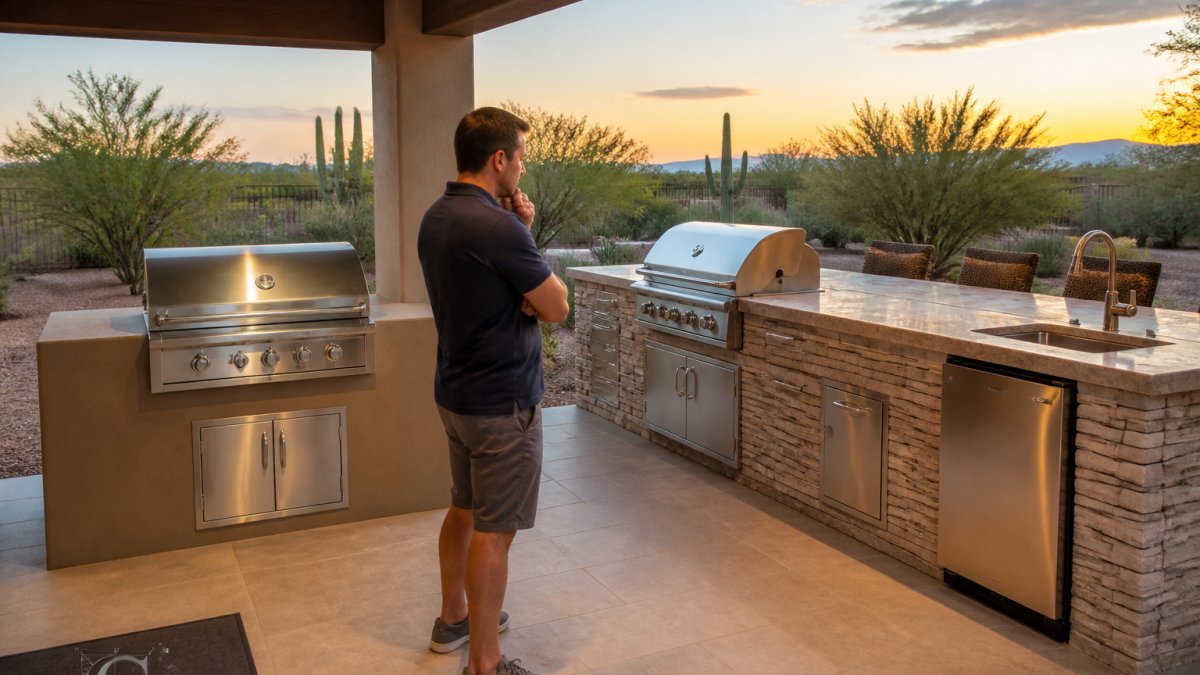
An outdoor kitchen combines a built-in grill with countertops, a sink, refrigeration, and storage in one permanent structure. A built-in grill station is smaller: a grill head set into a counter with access doors and drawers, no plumbing or electrical required.
That distinction drives cost, permitting, and build time. Below, we break down which one fits your backyard, budget, and how you cook.
Custom, Modular, and Pre-Fabricated: Three Build Paths
Three build paths exist, each trading cost against permanence. Custom masonry uses block, stone, or brick built on site, fitting any footprint but costing the most in labor. Modular grill islands arrive as pre-engineered panels with pre-cut openings for specific grill models. Pre-fabricated islands are the fastest route, delivered largely assembled.
The trade-off: modular and pre-fabricated systems often require a compatible grill model, while custom masonry accepts whatever built-in grill head you choose, including high-output models with infrared burners or a rotisserie kit.
Ask your contractor whether the island framing is engineered to support the grill’s weight plus a full propane tank or refrigerator. A loaded built-in refrigerator can add hundreds of pounds to one corner of the structure, and undersized framing shows up as cracked countertops within a year.
Side-by-Side Comparison: Cost, Utility Load, and Build Time
A grill station needs gas and nothing else. A full outdoor kitchen typically needs gas, electrical, and water, and each utility adds inspection time and cost.
| Factor | Built-In Grill Station | Full Outdoor Kitchen |
|---|---|---|
| Utilities | Gas line only | Gas, electrical, water |
| Typical components | Grill head, access doors, drawers | Grill, sink, fridge, storage, bar |
| Build time | Shorter | Longer, multi-trade |
| Permits | Often minimal | Usually required |
| Best for | Focused cooks, smaller patios | Entertainers, larger footprints |
The utility load is the hidden divider. Running a gas line is one trade; a sink means outdoor plumbing and a drain path; a refrigerator means a dedicated circuit. Each pulls in a separate licensed trade and inspection.
Outdoor Kitchen Cost Estimator: What Drives Your Number
No two outdoor kitchens cost the same, and any contractor quoting a flat number before seeing your yard is guessing. Your total depends on utility run length, countertop material, appliance count, and whether the site needs hardscaping or a concrete pad first.
Use this as a planning framework rather than a price list:
- Measure the counter run in linear feet, since material and framing scale with it
- Count every appliance: grill, side burner, refrigerator, sink, ice maker
- Note the distance from your gas meter and main electrical panel
- Decide whether you need a pergola or shade structure
- Confirm whether a concrete pad or hardscaping comes first
- Add a contingency for surprises found during demolition or trenching
A realistic outdoor kitchen cost estimator weighs all six. The two that surprise homeowners most are utility run distance and site prep: a grill station twenty feet from the meter is simple, while a full kitchen at the back of a large lot with a sink and fridge is a different project.
Where the Money Actually Goes
Most projects break into five cost buckets:
- Structure and framing, masonry, steel stud, or modular panel system, plus the concrete pad or footing it sits on
- Countertops, the single biggest swing item, since the same footprint can vary widely between poured concrete, porcelain tile, and natural stone slab
- Appliances, grill head, side burner, refrigerator, sink, ice maker, and any ventilation hood
- Utilities, gas line, electrical circuit(s), water supply, and drain, priced largely by trench length and whether the panel has spare capacity
- Finishes and shade, veneer, stucco, lighting, pergola, and any hardscaping tie-in
Appliances and countertops together consume roughly half the budget, while utilities and site prep consume the other half in ways homeowners rarely anticipate, which is why two kitchens with identical appliance lists can land thousands of dollars apart.
The Variables That Move Your Number Most
- Utility run distance. Every extra foot of trench for gas, electrical, and water adds labor, conduit, and inspection time.
- Panel capacity. If your main electrical panel is full, adding a dedicated circuit for a refrigerator or ice maker may require a panel upgrade.
- Countertop material. Poured concrete and porcelain tile sit at the lower end; natural stone slab and fabricated quartz at the higher end.
- Appliance count and grade. A single grill head and access doors is one tier; adding a side burner, refrigerator, sink, and ice maker is another, and each appliance adds its own utility hookup.
- Site prep. Removing existing concrete, regrading, or building a new pad adds cost before a single block is laid.
- Permits and inspections. Multi-trade projects typically require more permits and more inspection visits, each with its own fee and scheduling delay.
A Practical Way to Sanity-Check Any Quote
Ask any contractor to break their bid into the five buckets above. A single lump sum with no utility, countertop, or contingency line item is not a budget, it is a guess. A defensible bid shows:
- Linear feet of counter and the material selected
- Every appliance by model and BTU rating
- Trench length and panel capacity noted
- Permit responsibility spelled out
- A stated contingency percentage for site surprises
For current pricing on your layout, request a quote rather than relying on ballpark figures. A written, itemized bid is the only number worth comparing against another contractor’s.
Outdoor Kitchen Utility Requirements: Gas, Electrical, and Water
Outdoor kitchen utility requirements break into three systems, each with its own code and inspection path. Gas feeds the grill and side burners.
Gas line installation is the backbone.
Electrical work follows the National Electrical Code, which requires GFCI protection for outdoor receptacles.
Water is the line most homeowners underestimate. An outdoor sink needs a supply line and a drain strategy, and in freeze-prone areas the line must be winterized.
Materials That Survive Desert Heat and Monsoon Season
Material choice decides whether your outdoor kitchen looks new in a decade or needs rebuilding in five. Intense UV, 110-degree summers, and sudden monsoon moisture are brutal on the wrong materials.
Stainless steel grade matters most for the grill and hardware.
Countertop materials split into three practical camps:
- Natural stone handles heat well but needs sealing against stains
- Concrete is customizable and heat-tolerant but can crack without proper reinforcement
- Porcelain tile resists UV fading and cleans easily, though grout needs sealing
For cabinetry, weather-resistant materials beat standard wood every time. Powder-coated steel, marine-grade polymer, and masonry all survive monsoon season. Untreated wood warps, cracks, and grows mold.
Do not let a contractor frame your island with standard drywall or untreated lumber behind a stone veneer. Monsoon moisture finds its way in, and the frame rots from the inside while the exterior still looks fine. By the time you notice, the structure needs a rebuild.
Ergonomic Layout: Designing a Cooking Zone That Works
Ergonomics decide whether you enjoy cooking outside or dread it. The best layouts keep the grill, prep area, and storage within a few steps of each other.
Design around a cooking zone, not a wall of appliances.
Counter height matters too. Standard kitchen height is 36 inches, but many outdoor cooks prefer the grill slightly lower to see the cooking surface without stooping.
A common mistake is designing for looks first.
Resale Value and Total Cost of Ownership Over 10 Years
Most guides stop at the purchase price, but the number that matters is what the structure costs across a decade of ownership.
Resale Value: What Actually Transfers to a Buyer
A well-built outdoor kitchen can support resale value, but the return depends on how well it is built and how well it fits the home. Buyers treat a permanent outdoor living space as a feature, the way they treat a renovated kitchen indoors.
What tends to help resale:
- Permanence and integration. A structure that reads as part of the home, matching roof line, matching countertop, tied into the patio, shows better than a freestanding cart.
- Durable materials. A buyer’s inspector will note cracked countertops, rusted hardware, and rotted framing. Those become negotiation items.
- Utility completeness. A kitchen with a working sink, refrigerator, and lighting is a more complete feature than a grill head on a counter.
What tends to hurt resale:
- Non-permitted work. Unpermitted gas, electrical, or plumbing can surface during a buyer’s inspection and stall or kill a sale.
- Undersized framing. A structure that has already cracked once signals future repair costs to a buyer.
- Over-building for the neighborhood. A kitchen that outclasses the surrounding homes rarely returns its cost.
A built-in grill station is not a liability at resale, it is simply a smaller feature. It reads as a permanent, intentional cooking area rather than a portable grill, but it does not carry the same weight as a full kitchen with plumbing and refrigeration.
Total Cost of Ownership: The 10-Year Framework
TCO is the purchase price plus everything you spend to keep the structure working and looking right, broken into four lines:
1. Upfront build cost. The bid you sign. This is the only line most homeowners track.
2. Recurring maintenance.
- Natural stone and concrete countertops need sealing, typically yearly in sun-heavy climates, more often if exposed to monsoon runoff. Tile grout needs sealing on a similar cadence.
- Stainless steel benefits from periodic cleaning to prevent staining and pitting, especially near salt air or pool chemicals.
- Burners, ignition systems, and thermocouples are wear items; most gas grills need at least one ignition or burner service within a decade of regular use.
3. Fuel cost. This is the line nobody prices. Propane refills, natural gas consumption, and charcoal or pellet purchases all recur, and a grill used twice a week costs meaningfully more to fuel over ten years than one used twice a month. Natural gas is typically the lowest ongoing cost per cook; propane is convenient but requires refills; charcoal and pellets add a recurring consumable purchase.
4. Replacement and repair.
- A grill with 430-grade stainless steel may need replacing while a 304-grade unit is still going, and a structure framed with untreated lumber may need a rebuild that masonry or steel framing typically avoids.
- Refrigerators, ice makers, and other appliances have their own service life and will likely need at least one repair or replacement within ten years.
Why the Cheapest Build Rarely Wins the Decade
Cheaper builds cost more over ten years: untreated lumber may need a rebuild, and 430-grade steel may need replacing while a 304-grade unit is still going. The higher upfront cost of proper materials usually wins the decade.
The pattern is consistent: the gap between a budget build and a durable one often shrinks or reverses once you add ten years of sealing, service, fuel, and replacement.
The cheapest outdoor kitchen is rarely the least expensive one. Price the build, then price ten years of maintenance, fuel, and likely replacements. The gap between a budget build and a durable one often shrinks or reverses over a decade.
How to Run This Math for Your Own Project
Ask any contractor for three things before you sign:
- A list of every wear item and its expected service life
- The maintenance cadence the materials require, sealing, cleaning, and inspection
- The fuel type and an honest estimate of what it costs per cook at your usage rate
If a contractor cannot answer those three, they are selling you a build, not a decade of ownership. The happiest homeowners ten years in are the ones who priced the decade, not just the install.
Which One Fits Your Backyard and Budget?
Choose a full outdoor kitchen if you host regularly, want a sink and refrigeration outside, and have the footprint and budget for multi-trade work.
The deciding factor is usually not money but how you actually use the space.
Crosspoint Contracting has remodeled homes and commercial spaces across the Phoenix Valley for 16 years, with residential ROC 263190 and commercial ROC 283814.
Most homeowners underestimate the utility work that separates a simple grill station from a full outdoor kitchen.
Frequently Asked Questions
What are the disadvantages of an outdoor kitchen?
An outdoor kitchen costs significantly more than a built-in grill station because it adds plumbing, electrical work, countertops, and storage cabinetry. It also demands more maintenance, from sealing stone surfaces to winterizing water lines. In desert climates, sun exposure fades finishes faster and dust collects in open shelving. Permits and inspections add time to the build. If you grill a few times a month, the extra investment rarely pays off compared to a well-built grill station with stainless storage.
Are built-in grills worth it compared to a freestanding model?
A built-in grill head delivers better heat distribution, a longer warranty, and a cleaner look than most freestanding carts. The trade-off is installation: you need a masonry or modular island, plus a gas line and often an electrical connection for ignition and lighting. If you plan to stay in your home for years and grill weekly, the durability and resale appeal justify the cost. For occasional use, a freestanding grill is simpler.
How much does it cost to build an outdoor grill station versus a full outdoor kitchen?
A built-in grill station typically involves a grill head, an island structure, and basic storage. A full outdoor kitchen adds countertops, a sink, refrigeration, side burners, and more extensive utility hookups. Because pricing depends on materials, appliance brands, and site conditions, the reliable way to compare is an outdoor kitchen cost estimator or a contractor quote. Crosspoint Contracting provides free quotes with no hidden fees, so you can see line-item costs before committing.
What utility requirements should I plan for in an outdoor kitchen?
Outdoor kitchen utility requirements include a dedicated gas line sized for your BTU output, a GFCI-protected electrical circuit for ignition systems, lighting, and refrigeration, and a water supply with a drain line if you add a sink. Ventilation matters too: built-in grill heads need clearance from combustible surfaces, and any structure overhead needs proper exhaust. Check local building permits before trenching. A licensed contractor can map hookups to your home’s existing capacity.
Are built-in grills a good investment for home resale value?
Built-in grills and outdoor kitchens rank among the features buyers pay attention to in warm climates, but the return varies by market and build quality. A well-integrated grill station with weather-resistant cabinetry and quality stainless steel holds up better and photographs well in listings. A full outdoor kitchen with plumbing and electrical adds more perceived value but also more maintenance concerns for buyers. The strongest resale play is a clean, functional layout that matches the home’s style.