


Last Updated: October 22, 2026
Quick Summary
Marble countertop alternatives include quartzite, engineered quartz, porcelain, and sintered stone, each offering marble’s visual appeal with superior durability and lower maintenance. Quartzite provides the closest natural stone substitute with better stain and heat resistance, while marble-look quartz delivers engineered durability and a non-porous surface that requires no sealing.
- Quartzite resists etching and staining better than marble and tolerates direct heat from hot pans without damage.
- Engineered quartz doesn’t etch from acids like lemon juice or wine and requires no sealing due to its non-porous surface.
- Porcelain slabs are non-porous, extremely heat-resistant, and scratch-resistant but require professional installation due to their weight and brittleness.
- Sintered stone offers performance rivaling porcelain but has limited availability and fewer contractors experienced in installation.
- Sealing costs over 10-15 years can offset higher upfront prices for quartz, porcelain, and sintered stone compared to marble or quartzite.
Table of Contents
- Why Homeowners Choose Alternatives to Marble Countertops
- Quartzite Countertops vs Marble: The Natural Stone Comparison
- Marble-Look Quartz Countertops: Engineered Durability
- Porcelain Countertops That Look Like Marble
- Best Low-Maintenance Countertops for Kitchens
- Cost, Installation, and Selection: What Matters Most
- Frequently Asked Questions
Why Homeowners Choose Alternatives to Marble Countertops
Marble has long been the gold standard for luxury kitchens, beautiful, timeless, elegant. But most homeowners discover after living with it that marble is also fragile, high-maintenance, and expensive to repair.
When investing in a kitchen renovation, you want surfaces that look stunning AND perform under real-world conditions. That’s where marble countertop alternatives come in.
The shift away from marble isn’t about settling for less.
Your choice depends on three factors: how the surface will look, how it will perform, and what you’re willing to spend on maintenance. We’ll break down each major alternative so you can make an informed decision for your space.
Quartzite Countertops vs Marble: The Natural Stone Comparison
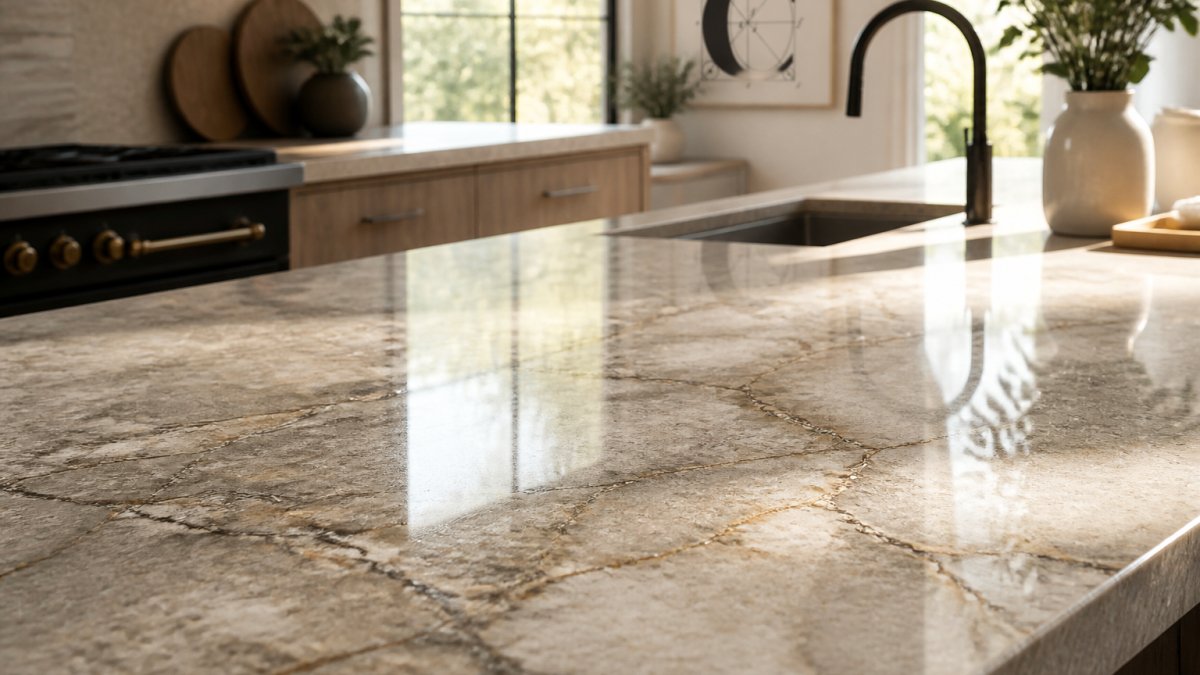
Quartzite is the closest luxury substitute for homeowners who want real stone without marble’s drawbacks.
Marble etches when acidic substances touch it, lemon juice, vinegar, wine all leave marks, and stains easily because it’s porous.
Quartzite also tolerates heat significantly better than marble, you can set a hot pot directly on it without worry, something you’d never do on marble.
The trade-off is cost. A full kitchen countertop project with quartzite depends on slab selection, fabrication complexity, and installation. That’s higher than many engineered alternatives, but lower than premium marble installations.
Quartzite requires professional fabrication and installation. The stone is dense and brittle, so cutting and shaping demands expertise, poor installation can lead to cracks and premature failure.
| Feature | Marble | Quartzite |
|---|---|---|
| Etching Resistance | Low (acids mark easily) | High (resists acids) |
| Stain Resistance | Low (porous) | High (dense) |
| Heat Tolerance | Moderate | High |
| Hardness | Soft (3-4 Mohs) | Hard (7 Mohs) |
| Maintenance | High (frequent sealing) | Moderate (occasional sealing) |
| Cost Range | $6,000-$18,000+ | $6,000-$18,000 |
Marble-Look Quartz Countertops: Engineered Durability
Quartz countertops engineered to look like marble are the most popular alternative in luxury kitchens: they combine the aesthetic you want with performance that holds up to daily cooking.
Manufacturers blend crushed natural quartz (roughly 90%) with polyester resins and pigments under vacuum and pressure to create a non-porous, uniform surface.
The durability advantage is real. Quartz doesn’t etch like marble because the resin matrix blocks the acid attack that dissolves calcium carbonate.
Color consistency is where quartz differs from marble. Each marble slab is unique; quartz offers predictability, you see the exact pattern before installation. Some homeowners love this consistency, others prefer marble’s natural variation.
Marble-look quartz visual quality has improved significantly.
Cost is typically lower than quartzite or marble: a full kitchen project with marble-look quartz depends on collection, edge profile, and cutouts.
Two limitations matter in a luxury kitchen. First, extreme heat can discolor or damage the resin (a hot pan left sitting), so use trivets and consider a landing zone near the range. Second, UV exposure can shift some quartz colors, particularly lighter, resin-heavy designs, in rooms with intense direct sunlight; less an issue in interior kitchens than sunrooms, but worth asking the fabricator about for south- and west-facing spaces.
| Feature | Marble | Marble-Look Quartz |
|---|---|---|
| Etching Resistance | Low (acids mark easily) | High (resin matrix resists acids) |
| Stain Resistance | Low (porous) | High (non-porous) |
| Heat Tolerance | Moderate | Moderate (resin can scorch) |
| Hardness | Soft (3-4 Mohs) | Hard (6-7 Mohs equivalent) |
| Maintenance | High (frequent sealing) | Low (no sealing) |
| Typical Installed Cost (50-60 sq ft with island) | $6,000-$18,000+ | $4,500-$12,000 |
Ask your fabricator for the slab’s dye-lot and bookmatch options before you commit. Quartz is manufactured in batches, and two slabs from different lots can read slightly differently side by side, which matters most on large islands and waterfall edges.
Porcelain Countertops That Look Like Marble
Porcelain slabs are the newest frontier in marble alternatives: large-format tiles made from porcelain fired at extremely high temperatures, engineered to replicate marble’s appearance with exceptional durability.
Porcelain countertops are non-porous (no sealing, stain-resistant), extremely heat-resistant, far more so than quartz, and incredibly scratch-resistant due to their hardness. For a high-use kitchen, porcelain performs exceptionally well.
The challenge with porcelain is installation. These slabs are heavy and brittle, requiring precise cutting and professional installation, if not installed correctly, they can crack, compromising the entire surface.
Fabrication options are more limited than with quartz: edge profiles can’t be customized as extensively, and sink cutouts require specialized equipment. Most standard configurations are still straightforward.
Cost generally falls in the mid-range between quartz and premium quartzite. Porcelain is gaining popularity, making installation expertise more available.
Best Low-Maintenance Countertops for Kitchens
If maintenance is your primary concern, you want surfaces that don’t require sealing, resist staining and etching, and clean up easily.
Engineered quartz and porcelain are the clear winners: both are non-porous (no sealing), resist staining from common kitchen substances, and clean up easily with soap and water or a mild cleaner.
Quartzite requires occasional sealing, making it slightly higher maintenance than quartz or porcelain. Natural marble requires frequent sealing and careful handling, the highest-maintenance option.
For families with young children, busy schedules, or those who simply don’t want to think about their countertops, engineered stone is the practical choice: a beautiful surface without the constant upkeep.
Sintered Stone and Other Performance Materials
Sintered stone is an emerging category worth understanding. It’s created by compacting mineral particles under extreme heat and pressure, resulting in a surface that’s incredibly dense and durable.
Sintered stone offers performance that rivals or exceeds porcelain. It’s heat-resistant, scratch-resistant, and non-porous. It doesn’t require sealing. For homeowners seeking maximum durability, sintered stone is compelling.
The limitation is availability and contractor familiarity. Sintered stone is newer to the market, so fewer contractors have experience installing it. Pricing can be higher due to limited supply and specialized installation requirements.
Soapstone and Dolomite: Softer Alternatives
Soapstone and dolomite offer a different aesthetic, one that’s less about replicating marble and more about embracing a distinctive look.
Soapstone is a soft, dense metamorphic rock with a smooth, matte finish. It’s non-porous and doesn’t require sealing. It’s heat-resistant and won’t etch. The downside: it’s softer than marble, so it scratches more easily.
Dolomite is harder than soapstone but softer than quartzite. It has a similar aesthetic to marble but with different veining patterns. It requires sealing and has moderate stain resistance. It’s less common than other alternatives, which means fewer slab options and potentially higher costs.
Both materials appeal to homeowners seeking a distinctive, artisanal look rather than a marble replica. They’re not trying to look like marble, they’re making a different design statement.
Cost, Installation, and Selection: What Matters Most
The material itself is only part of the equation. Installation quality, slab selection, edge profiles, and long-term maintenance all affect the final result and the true cost of ownership. This is where a luxury kitchen decision is won or lost, and where most roundups stop short.
Installed Cost Ranges by Material
Material pricing alone misleads. The number that matters is the installed price for a typical kitchen with an island, including fabrication, edge profiles, sink and cooktop cutouts, and installation. As a planning range, pricing depends on material, slab rarity, fabrication complexity, collection, edge profile, cutouts, installation expertise, slab thickness, edge detail, and slab options.
These are planning ranges, not quotes. Slab size, vein matching, edge profile, and the number of cutouts move the number significantly.
Fabrication and Installation Costs
Fabrication is often 30-50% of the installed price and is where quality diverges. Edge profiles range from simple eased edges to ogee, bullnose, and mitered waterfall edges; the more complex the profile, the more labor and the higher the risk of visible seams. Sink cutouts, cooktop openings, and backsplash transitions all need careful measurement and cutting. Poor fabrication leads to visible gaps, uneven surfaces, and potential water damage.
Installation must be done correctly. Countertops need proper support, level installation, and secure fastening. Undermounting (where the sink or cooktop is attached from below) requires structural support and careful sealing. Surface mounting is simpler but less elegant. For heavy porcelain and sintered stone slabs, installation often requires a two- or three-person crew and specialized lifting equipment, which is a real line item.
Lifetime Ownership Costs
Sealing is the hidden recurring cost. Natural marble typically needs sealing every 6-12 months, and quartzite every 12-24 months. Quartz, porcelain, and sintered stone need no sealing, which over a 10-15 year kitchen life can offset a meaningful share of a higher upfront price.
Repairability also affects lifetime cost. Quartz chips can often be repaired by a fabricator with color-matched resin; marble etching can be polished out but recurs; porcelain chips are harder to disguise and may require slab replacement in visible areas. Ask your contractor how each material is repaired before you choose, not after.
Slab Selection and Design Details
Slab selection is where your contractor’s expertise becomes valuable. Even within a single material type, slabs vary in color, veining, and pattern. The best contractors help you select slabs that work together and complement your kitchen’s overall design. This is especially important with natural stone, where each slab is unique, and with bookmatched islands and waterfall edges, where vein continuity across seams is the difference between a showpiece and a patchwork.
At Crosspoint Contracting, we handle the entire process, from slab selection through final installation. We work directly with the owner, not a rotating cast of project managers, to understand your vision, your lifestyle, and your maintenance preferences. Then we recommend materials that match your actual needs, not just your initial aesthetic preference.
When comparing costs, ask contractors for the total installed price, not just material cost, and ask separately for sealing and repair costs over the first five years. Installation quality varies significantly, and the cheapest option isn’t always the best value. A well-installed mid-range surface will outperform a poorly installed premium one.
The right choice depends on your priorities. Among marble countertop alternatives, quartzite offers the closest thing to marble with better performance. If you want a marble look with minimal maintenance, engineered quartz wins. If you prioritize maximum durability, porcelain or sintered stone are worth considering. If you want a distinctive patina, soapstone and dolomite make a different statement entirely.
Frequently Asked Questions
What is the best alternative to marble countertops?
The best alternative depends on your priorities. Quartzite offers the closest luxury feel to marble with superior durability and scratch resistance. Engineered quartz provides consistent appearance and low maintenance. Porcelain slabs deliver a marble look with excellent stain and heat resistance. For busy kitchens, low-maintenance engineered materials often outperform natural stone. Consider your cooking habits, budget, and lifestyle when selecting a marble countertop alternative.
Is quartzite a better choice than marble for kitchen countertops?
Quartzite generally outperforms marble in kitchens. While both are natural stone, quartzite is significantly harder and more resistant to scratching, etching, and staining. Marble requires regular sealing and careful maintenance to prevent damage from acids and moisture. Quartzite maintains its appearance with minimal sealing. For high-use kitchens, quartzite countertops vs marble comes down to durability: quartzite wins for practical kitchen performance while marble remains more elegant but demanding.
Which countertop materials look like marble but are easier to maintain?
Marble-look quartz countertops and porcelain slabs both replicate marble’s aesthetic with significantly less maintenance. Engineered quartz resists staining, scratching, and etching without sealing. Porcelain countertops that look like marble offer similar durability plus superior heat resistance. Both materials clean easily with mild soap and water. Sintered stone provides another option with exceptional performance. These engineered alternatives preserve marble’s luxury appearance while eliminating the high maintenance demands of natural marble.
What should I expect to pay for a luxury kitchen countertop project?
Full kitchen countertop projects with island depend on material, square footage, and complexity. Installed costs vary significantly based on slab selection, edge profiles, fabrication requirements, and local installation rates. Crosspoint Contracting provides transparent pricing with no hidden fees, contact us for a free quote tailored to your specific kitchen renovation. Our design-build approach helps manage costs while delivering the luxury finish you want.
