


Table of Contents
- The Real Math: Outdoor Kitchen ROI in Phoenix
- Best Materials for Desert Outdoor Kitchens
- Custom Outdoor Kitchen Cost: What Drives the Price
- Utility and Infrastructure Costs Most Homeowners Miss
- HOA and Permitting Rules for Phoenix Backyard Builds
- Seasonal Usage and Energy Efficiency: What the Desert Demands
- Designing a Backyard Layout That Works Year-Round
- Conclusion
- Frequently Asked Questions
Last Updated: September 24, 2026
The Real Math: Outdoor Kitchen ROI in Phoenix
For most Phoenix homeowners, the question of whether is an outdoor kitchen worth it in Phoenix comes down to whether you plan to stay several years and use the space regularly. The value isn’t a guaranteed resale bump, it’s usable square footage, lower summer entertaining costs, and a feature local buyers actively look for.
What Appraisers and Buyers Actually Pay For
Appraisers don’t assign a fixed dollar value to a grill island the way they do a bedroom or bathroom. They respond to functional outdoor living space that reads as permanent, finished, and integrated with the house.
Buyers in the Valley tend to pay for:
- Built-in structures, not freestanding carts that look temporary
- Shade, because an uncovered patio is unusable from June through September
- Materials that match the home’s exterior, which signals quality construction
When the Numbers Stop Working in Your Favor
The ROI case falls apart in three scenarios: you sell within a year or two and absorb the full cost without the years of use that justify it; the build is oversized for the neighborhood and prices you above what the local market supports; or the materials fail early. A countertop that cracks after two summers or a grill that rusts out in three years turns an asset into a liability you must disclose.
Building an elaborate outdoor kitchen right before listing your home is often a money-losing move. Buyers discount features they didn’t choose, and you never get to enjoy the space you paid for.
Best Materials for Desert Outdoor Kitchens
Material selection is where desert builds succeed or fail. The wrong countertop cracks, the wrong cabinet fades, the wrong finish traps heat. Choose for heat, sun exposure, and dust, not for how a showroom looks in air conditioning.
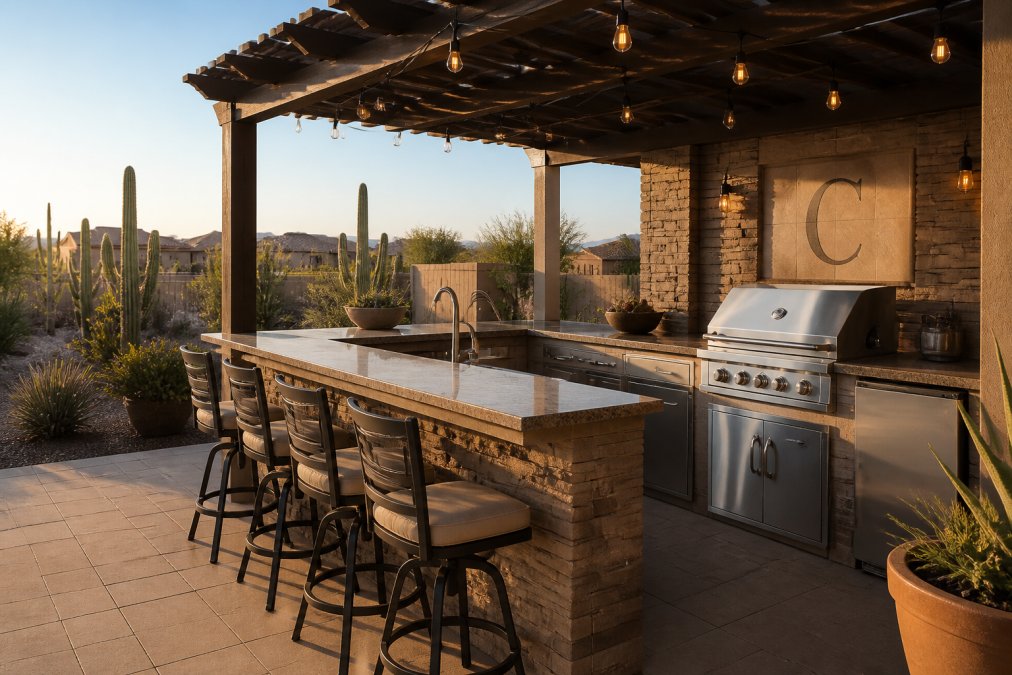
Countertops, Cabinets, and Stone Veneer That Survive 115°F
The best countertops for desert outdoor kitchens have low heat absorption, high thermal stability, and UV-fade resistance. Granite, certain quartzites, and poured concrete perform well when properly sealed. Dark surfaces absorb heat and become too hot to touch, so lighter tones are the practical choice.
Shade Structures and Ventilation That Protect Your Investment
Shade is not optional here. A pergola, ramada, or covered patio dramatically extends usable hours and protects people and equipment. Ventilation matters just as much: built-in grills need clearance and airflow so heat doesn’t cook the surrounding structure.
Orient your cooking surface so the cook faces away from the late-afternoon sun. It sounds minor until you’re standing at a 500°F grill at 5 p.m. in July with the sun in your eyes.
Custom Outdoor Kitchen Cost: What Drives the Price
Custom outdoor kitchen cost in the Valley is driven by four factors: size and layout, material grade, appliance selection, and infrastructure. A simple built-in grill with a counter runs far less than a full kitchen with sink, refrigerator, and bar seating. Investing in durable outdoor kitchen components ensures that these structural elements withstand the intense desert heat while maintaining their functional integrity over the long term.
| Cost Driver | What It Includes | Why It Moves the Price |
|---|---|---|
| Layout and size | Island length, seating, bar height | More linear feet means more masonry and countertop |
| Material grade | Stone veneer, granite, concrete | Premium finishes cost more but last longer |
| Appliances | Grill, side burner, fridge, sink | Built-in units cost more than freestanding |
| Infrastructure | Gas lines, electrical, plumbing | Distance from existing utilities is the biggest variable |
Custom Masonry vs. Prefab Kitchen Islands
Custom masonry gives you a structure built to your space, matched to your home, and repairable over time. A prefab island is faster and cheaper up front but limits your layout and often uses lighter materials that age faster in extreme heat.
Utility and Infrastructure Costs Most Homeowners Miss
This line item surprises people. The visible kitchen, masonry, countertop, appliances, is only part of the project. Running gas, electrical, and water to a detached outdoor location often costs as much as the appliances themselves, and the biggest variable is distance from the house’s existing service points.
-
Gas. A built-in grill plus a side burner needs a properly sized line and, in most cases, a dedicated shutoff at the kitchen. If the meter or existing gas stub is on the opposite side of the house, the trenching and line length, not the pipe itself, is what moves the price. Undersized gas lines are the most common cause of a grill that won’t reach searing temperature.
-
Electrical. Plan for dedicated circuits, not a tapped patio outlet. Lighting, a refrigerator, a kegerator, and outlets for tools or a rotisserie each draw load, and GFCI protection is required for outdoor receptacles. A subpanel is sometimes the cleanest solution when the main panel is already near capacity.
-
Water and drainage. A sink means a supply line plus a drain path. In desert lots, running a drain to an appropriate discharge point, not just dumping onto the patio, is a design decision, not an afterthought.
-
Permits and inspections. Gas and electrical work generally requires permits and inspection, and that cost is tied to the utility scope, not the masonry.
-
Trenching through mature desert landscaping, caliche, or a paver patio costs more than trenching open dirt. Route utilities before hardscape goes in, not after.
-
Locate existing irrigation, pool plumbing, and sewer lines before you dig. Hitting a pool line during a gas trench is an expensive surprise.
-
Size the gas line and electrical panel for what you might add later. Upgrading capacity after the countertop is set is far more disruptive than doing it once.
Budget infrastructure as its own line item, separate from the kitchen itself. If your patio is far from the gas meter and main panel, expect that line to be a meaningful share of the total, and design the layout around shortening those runs where you can.
HOA and Permitting Rules for Phoenix Backyard Builds
Most outdoor kitchen guides leave this out, yet it’s what most often delays or kills a project. In the Valley, two approval tracks run in parallel, your HOA’s architectural review and your municipality’s building permits, and neither cares that the other exists. Start both early.
HOA Architectural Review
Most Valley HOAs regulate backyard structures, and many require architectural review and written approval before any work begins. Common requirements include:
- Material matching. The structure’s finish often must match or complement the home’s exterior. Stone veneer and stucco that echo the house clear this hurdle more easily than a contrasting finish.
- Height and setback limits. Pergolas, ramadas, and covered structures frequently have maximum heights and minimum distances from property lines. These vary widely by community.
- Separate approvals. Shade structures, masonry, and utility work are often reviewed as distinct items, so a single approval may not cover the whole build.
- Submittal packages. Expect to provide a site plan, elevations, and material samples. Incomplete submittals are the most common cause of a slow review.
Municipal Permitting and Inspection
On the permitting side, gas and electrical work generally requires permits and inspection at defined stages, rough-in before the countertop and veneer go on, final after everything is set. Cover the gas line or bury the conduit before rough inspection and you may be asked to open it back up.
- Whether a separate permit is required for the shade structure
- Setback and easement requirements for your specific lot
- Whether the utility work requires a licensed trade to pull the permit
Verifying Your Contractor
Before you sign, verify that any contractor you hire holds a current license. Arizona Registrar of Contractors license lookup lets you confirm license status, classification, and complaint history. A contractor who is properly licensed, bonded, and insured will have no problem with you checking, and a contractor who resists it is telling you something.
The two delays that can impact outdoor kitchen timelines are HOA architectural approval and utility permitting. Start both before you finalize your design, not after. A build that is ready to break ground but waiting on paperwork can cost time and impact a contractor’s schedule.
Seasonal Usage and Energy Efficiency: What the Desert Demands
Realistic seasonal usage matters more than marketing promises. In the Valley, an outdoor kitchen is genuinely comfortable roughly October through April, usable in shoulder months with shade and misting, and largely idle at summer’s peak unless you have strong shade and evening timing.
Designing a Backyard Layout That Works Year-Round
A backyard layout that works year-round starts with shade and circulation, not the grill. Map how people move from house to patio, where they’ll sit, and where the cook stands. Keep the cooking zone out of the main traffic path so guests aren’t walking behind a hot grill.
Prioritize in this order:
- Shade structure and orientation
- Utility runs and their distance from the house
- Cooking surface and counter space
- Seating and bar area
- Storage and dust protection
Conclusion
The challenge with any outdoor build is that the decisions that determine whether it was worth it, materials, infrastructure, layout, and permits, all get made before you see the finished space. Get those right and a Phoenix outdoor kitchen becomes one of the most-used parts of your home. Get them wrong and it becomes a repair bill.
Frequently Asked Questions
What are the downsides of having an outdoor kitchen in Phoenix?
The main downsides are heat-related wear, dust accumulation, and seasonal underuse. Extreme summer temperatures can degrade lower-quality materials, fade finishes, and shorten appliance longevity. Dust storms coat cooking surfaces and ventilation grills, so a regular maintenance schedule matters more here than in milder climates. Some homeowners also find that July and August heat keeps them indoors, meaning the space gets heavy use in spring, fall, and winter but sits idle mid-summer. Choosing climate-resilient materials and adding shade structures reduces most of these problems.
Does an outdoor kitchen increase property value in Phoenix?
It can, but the increase depends on build quality, material choices, and how well the space fits the home. Buyers in the Phoenix Valley respond to outdoor living space that looks finished and functional, not improvised. A well-built grill island with stainless steel appliances, durable countertops, and proper shade tends to support resale value better than a bare built-in BBQ. Outdoor kitchen ROI is rarely dollar-for-dollar, so treat it as a lifestyle upgrade first and an investment second. A licensed contractor can help you prioritize features that hold value.
What materials hold up best in extreme heat and sun exposure?
For desert outdoor kitchens, the most reliable choices are natural stone or poured concrete countertops, stainless steel appliances rated for outdoor use, and stone veneer over masonry for the island structure. Powder-coated or stainless cabinets outperform standard wood, which warps and cracks under intense sun exposure. Rust-resistant hardware and sealed countertops reduce dust damage. Avoid dark, heat-absorbing surfaces on the cooking side, and plan shade structures or a pergola to cut direct sun on the cooking surface and extend appliance longevity.
How much does a custom outdoor kitchen cost to install in Phoenix?
Custom outdoor kitchen cost depends on size, materials, appliance selection, and utility work. A gas line run, electrical infrastructure for lighting and refrigeration, and any shade structure add to the base build. Site access, HOA requirements, and permit fees also affect the total. Because pricing varies this widely, get a written, itemized quote rather than comparing ballpark figures. Crosspoint Contracting provides free quotes and walks you through line-item costs so there are no hidden fees later.