


Table of Contents
- What Budget Creep and Scope Creep Actually Cost You
- Set a Realistic Remodel Budget Before Work Begins
- Build a Line-Item Budget That Matches Your Scope
- Use a Renovation Scope of Work Template to Lock Decisions
- Size Your Remodeling Contingency Budget and Set Rules for Using It
- Follow a Home Renovation Change Order Process for Every Change
- Track Spending With a Remodeling Cost Tracking Spreadsheet
- Evaluate Contractor Estimates Apples-to-Apples
- Frequently Asked Questions
Last Updated: October 6, 2026
What Budget Creep and Scope Creep Actually Cost You
Budget creep is the slow, quiet rise in a project’s cost that happens when small upgrades and add-ons pile up. Scope creep is the related problem: the work itself keeps growing beyond what you planned.
At Crosspoint Contracting, we have watched this play out on jobs across the Phoenix Valley for 16 years. The pattern is almost always the same. It rarely starts with one big blow-up. It starts with ten small yeses.
Here is what makes budget creep so frustrating:
- Each individual upgrade feels reasonable on its own
- No single decision looks like it will break the budget
- The damage only becomes clear when the invoices stack up
- By then, the money is already spent
The good news is that budget creep is preventable. It comes down to planning, early decisions, and one firm rule about changes. Below, we walk through how to prevent budget creep in home remodeling, step by step.
Most overruns are not caused by one disaster. They are caused by dozens of small, unplanned upgrades that each seemed harmless at the time.
Set a Realistic Remodel Budget Before Work Begins
A realistic remodel budget starts with two numbers: what you can afford, and what your home can support. Many homeowners skip the second one.
Spending far more than nearby comparable homes justify is called over-improving. It is one of the most common and most expensive mistakes in high-end renovation. A kitchen that outclasses every other home on the block rarely returns the money you put in.
So set your budget in this order:
- Decide the total you can spend without touching emergency savings.
- Check what comparable homes in your area are worth.
- Cap your project so it stays in line with those homes.
- Add a separate contingency fund on top (more on this below).
A renovation budget is not just a wish list. It is a spending plan with a ceiling you commit to before the first hammer swings.
Build a Line-Item Budget That Matches Your Scope
A line-item budget breaks the project into every cost you expect, instead of one lump sum. This is where a real renovation budget separates itself from a guess.
Your line-item budget should list each category with a dollar figure:
- Labor costs
- Cabinetry and countertops
- Appliances
- Plumbing fixtures
- Flooring, tile, and stone
- Lighting and electrical
- Paint and finishes
- Permits and fees
- Contingency
For each line, note whether the figure is a firm price or an allowance. An allowance is a placeholder for something you have not picked yet, like tile or fixtures. Allowances are where budget creep hides. If you allow for a basic tile and then fall for an imported stone, that gap comes straight out of your contingency.
Match every line to your written scope of work. If a cost has no matching scope item, one of the two is wrong.
Use a Renovation Scope of Work Template to Lock Decisions
A renovation scope of work template is a written document that lists exactly what will and will not be built. It is the single best defense against scope creep.
Here is a simple template you can fill in and share with your contractor:
PROJECT: ______________________
ADDRESS: ______________________
TOTAL BUDGET: $______________
CONTINGENCY (separate): $______________
IN SCOPE (must-haves):
OUT OF SCOPE (nice-to-haves, not included):
FIXED SELECTIONS (locked, no changes after this date):
- Cabinetry: ______________________
- Countertops: ______________________
- Flooring: ______________________
- Fixtures: ______________________
DECISION DEADLINE: ______________
CHANGE ORDER RULE: All changes must be approved in
writing before work begins.
The out-of-scope list matters as much as the in-scope list. It gives you a place to park ideas without derailing the build. When someone asks for a “small add,” you point to the list.
Write your must-haves and nice-to-haves down before you get quotes. The nice-to-haves become your upgrade menu, and you only touch that menu if contingency money is left over at the end.
Size Your Remodeling Contingency Budget and Set Rules for Using It
A remodeling contingency budget is money set aside for surprises you cannot yet see. It is not part of your upgrade fund. It is your safety net, and it needs a number, not a vibe.
Most practitioners size the reserve as a percentage of the hard construction cost, then adjust up or down based on how much is still unknown. A common starting framework:
| Project Type | Typical Contingency | What Drives the Number |
|---|---|---|
| Cosmetic refresh (paint, flooring, fixtures, no walls opened) | 5-10% | Few hidden conditions; selections already locked |
| Kitchen or bath remodel | 10-20% | Plumbing, electrical, and venting surprises behind walls |
| Whole-home or pre-1980 home | 15-25% | Aging wiring, galvanized or cast-iron plumbing, asbestos, structural quirks |
| Structural work or additions | 20%+ | Foundation, framing, and engineering unknowns |
Three variables push you toward the top of the range:
- Home age. A 1970s house with quirky plumbing and aging wiring can hide problems that only appear once walls are open. That is not a contractor inventing costs; it is the reality of old construction.
- Design completeness. If selections are locked and drawings are final, you can sit at the low end. If you are still choosing finishes, budget higher.
- Uncertainty of the discovery. Anything requiring demolition to assess (rot, moisture, prior unpermitted work) earns a larger reserve.
Set firm rules for using the fund:
- Spend it only on hidden conditions, code-required corrections, or true must-haves.
- Never use it for upgrades you simply want.
- Track every withdrawal in writing, with the reason and the date.
- Replenish it if you add scope that consumes part of it.
- If it drops below roughly half its starting balance, pause and re-plan before continuing.
What qualifies as a contingency expense:
- Yes: rotted subfloor found under tile, knob-and-tube wiring that must be replaced to pass inspection, a failed shutoff valve discovered during demo, a permit-driven change required by the local building department.
- No: upgrading from laminate to quartz because you saw a better sample, adding a pot filler, moving a wall you decided you did not like, changing cabinet hardware after install.
The fastest way to blow a budget is to treat contingency money as spending money. Once it is gone, every surprise becomes a crisis, and the next surprise is usually the one that stops work.
Follow a Home Renovation Change Order Process for Every Change
A home renovation change order process is the paperwork that controls mid-project changes. No signed change order, no change. That one rule prevents most budget creep.
A change order is not a text message or a verbal yes. It is a written document that both parties sign before any related work begins. At minimum, it should capture:
- Change number and date so it can be logged against the running total
- Description of the change in plain language, tied to the original scope item it modifies
- Reason (homeowner request, hidden condition, code requirement, design conflict)
- Cost breakdown, labor, materials, permits, and any subcontractor markup shown separately
- Schedule impact in working days, not just ‘a little longer’
- Effect on the contract total and the remaining contingency balance
- Payment terms for the added work
- Signatures from both the homeowner and the contractor’s authorized representative
Here is the approval workflow to run for every request:
- Request in writing. You or the contractor describes the change. Verbal requests get written down before anyone acts.
- Price it fully. The contractor provides cost and time impact. Ask what is included and what is excluded.
- Check the full impact. Add the change order cost to committed costs, not just to what you have paid. Compare the new total against your contingency balance and your overall ceiling.
- Decide. Approve, decline, or postpone. Postponing is a real option, park it on the nice-to-have list for the end of the project.
- Sign before work starts. No signature, no work. This protects both sides.
- Log it. Add the change order to your running total and update your cost tracking spreadsheet the same day.
Most guides tell you to avoid mid-project changes. That is good advice, but it is incomplete. Some changes are unavoidable, especially in older homes. The real skill is having a process ready for the ones you cannot dodge.
When a change is truly unavoidable, apply this test:
- Does it affect safety or code? Then it is required. Approve it, document it, and move on.
- Does it protect the home from future damage? Then it is worth it, water intrusion, structural rot, and failed waterproofing only get more expensive later.
- Is it purely cosmetic? Then it waits until the end, if money remains.
Ask your contractor to flag any change order that pushes the project total above your agreed ceiling. That single trigger turns a slow drip of small approvals into a decision you make on purpose, not one that happens to you.
Track Spending With a Remodeling Cost Tracking Spreadsheet
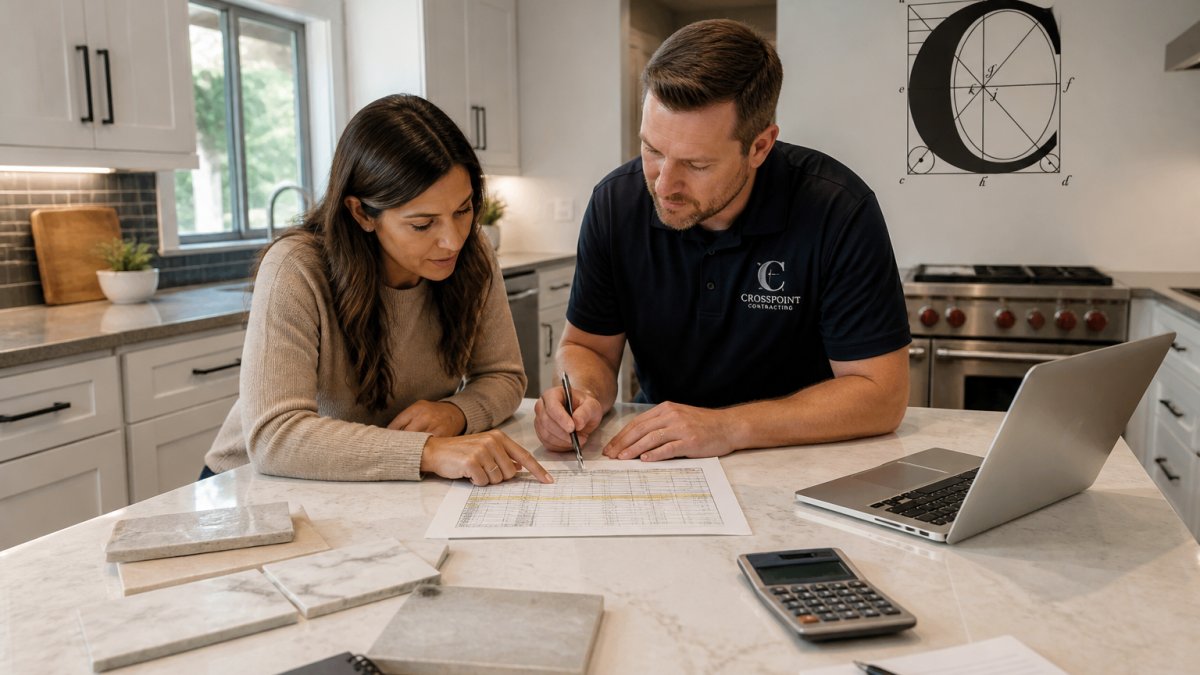
A remodeling cost tracking spreadsheet compares what you planned to spend against what you have actually spent, line by line. This is how you catch budget creep while you can still stop it.
Keep it simple. One row per budget line, with four columns:
| Line Item | Budgeted | Committed | Actual |
|---|---|---|---|
| Cabinetry | $ | $ | $ |
| Countertops | $ | $ | $ |
| Flooring | $ | $ | $ |
| Contingency | $ | $ | $ |
Update it weekly. “Committed” means money you have agreed to spend but not yet paid. That column is the early warning system. By the time a cost shows up as “actual,” it is too late to change course.
Evaluate Contractor Estimates Apples-to-Apples
Comparing contractor estimates is where many homeowners accidentally create their own budget creep.
To compare fairly, check that each estimate includes:
- A written scope of work, not just a total
- Labor and materials listed separately
- Allowances clearly marked as allowances
- Permit costs named
- A payment schedule tied to milestones
- A stated change order process
If one bid is far lower than the rest, find out why. It usually means something is missing.
The Federal Trade Commission’s consumer guidance on hiring contractors suggests getting multiple written estimates and never paying in full upfront. The U.S. Department of Housing and Urban Development’s guidance on home improvements also points homeowners toward written contracts that spell out the work, the materials, and the payment terms.
This is also where a good contractor earns trust.
Budget creep rarely announces itself. It arrives one small “yes” at a time, and by the time you notice, the money is gone.
At Crosspoint Contracting, we build those habits into every project. We work with you directly, the owner, not a rotating cast of project managers.
Get a Free Quote from Crosspoint Contracting and start your remodel with a budget that holds.
Frequently Asked Questions
What causes a home remodeling budget to increase?
Most overruns come from mid-project changes, incomplete scope documents, and hidden conditions discovered after demolition. When homeowners delay material selections, contractors must guess or pause work, and guesses often get replaced with pricier options later. Unexpected structural, plumbing, or electrical issues in older homes also add cost. A detailed scope of work, early design decisions, and a funded contingency reserve address the three biggest drivers before construction starts.
How much contingency should I include in a remodeling budget?
A common starting point is 10 to 15 percent of the construction budget for straightforward remodels, and 15 to 20 percent for older homes or projects that open walls. The contingency is not extra spending money; it covers hidden conditions and unavoidable discoveries. Set written rules for when you will tap it, such as structural repairs or code-required corrections, and require any other use to go through a change order instead.
How can I prevent scope creep during a renovation?
Finalize designs, finishes, and major material selections before demolition begins. Write them into a signed scope of work that lists specific products, quantities, and allowances. Once construction starts, route every new request through a formal change order process with pricing and a schedule impact stated in writing. Homeowners who make major decisions early and resist mid-project upgrades consistently keep their remodel budget closer to the original number.
What should I do if my contractor finds unexpected damage?
Ask for written documentation: photos, a description of the condition, and a line-item price to fix it. Compare that price against your contingency budget and decide whether to proceed, pause, or revise the scope. A discovery is not automatically a change order; it becomes one once you approve the repair in writing. Contractors who communicate same-day and provide real-time updates make this decision easier because you see the problem and the cost before work continues.