


Table of Contents
- Step 1: Set a Realistic Home Renovation Budget Before You Plan Anything
- Step 2: Prioritize Renovation Projects by ROI and Urgency
- Hidden Costs of Home Remodeling You Need to Budget For
- Use a Renovation Budget Spreadsheet Template to Track Every Dollar
- Best Ways to Finance Home Renovations in 2026
- Step 3: Manage Your Home Renovation Budget Through the Build
- Conclusion
Last Updated: August 15, 2026
Step 1: Set a Realistic Home Renovation Budget Before You Plan Anything
A home renovation budget is a detailed financial plan that accounts for every cost category before work begins. Getting this right upfront is the single most important thing you can do, most problems that spiral out of control trace back to a budget that was too vague, too optimistic, or built without the right inputs.
At Crosspoint Contracting, we’ve managed high-end kitchen remodels, whole-house renovations, and commercial tenant improvements for 16 years. The pattern we see repeatedly: homeowners who struggle mid-project didn’t under-fund the work. They under-planned it.

Setting a realistic home renovation budget is a learnable process. Below, we’ll walk through how to calculate costs by category, build in the right financial cushion, prioritize projects for maximum return, track spending through the build, and handle the hidden costs most guides gloss over.
Calculate Total Project Costs by Category
The biggest mistake homeowners make is treating renovation costs as a single number. Break your project into categories: labor costs, materials, permit fees, design fees, and appliances or fixtures. Each category behaves differently and carries different risk.
Labor typically represents a significant portion of any renovation budget. Material costs fluctuate based on supply chain conditions, and permit fees vary by municipality and project scope. Getting contractor estimates for each category separately gives you a clearer picture than a single lump-sum quote.
| Cost Category | What to Include | Notes |
|---|---|---|
| Labor costs | Framing, electrical, plumbing, finish work | Get itemized bids |
| Materials | Tile, lumber, fixtures, cabinetry | Lock in prices early |
| Permit fees | Building, electrical, plumbing permits | Check local requirements |
| Design fees | Architect, interior designer | Often 10-15% of project cost |
| Appliances/fixtures | Ranges, sinks, lighting | Allow for lead times |
| Contingency fund | Unexpected structural issues | 15-20% of total budget |
Request itemized bids from contractors rather than a single project total. This makes it far easier to compare quotes, spot discrepancies, and control costs when changes arise.
Build in a Contingency Fund
A contingency fund is a dedicated cash reserve set aside to cover unexpected costs that emerge during construction. For most renovations, a contingency of 15-20% of your total project budget is the standard recommendation.
Older homes, especially those built before 1990, routinely reveal surprises once walls open: outdated wiring, galvanized plumbing, inadequate insulation, or structural issues. According to the National Association of Home Builders, unexpected structural and systems issues are among the most common reasons renovation projects exceed their original budgets.
The contingency fund should sit in a separate account, untouched unless a genuine unexpected cost arises. If you finish the project without touching it, you’ve just built equity.
Step 2: Prioritize Renovation Projects by ROI and Urgency
Not all renovation projects are created equal. Some protect your home’s structural integrity; others improve livability; others are purely cosmetic. Prioritizing correctly means you don’t spend capital on a new backsplash while a failing roof quietly destroys your home’s market value.
Project prioritization should follow two axes: urgency and return on investment. Urgent projects prevent further damage or safety risk. High-ROI projects add measurable value relative to their cost.
Structural Improvements vs. Cosmetic Updates
Structural improvements, foundation work, roof replacement, HVAC systems, electrical panel upgrades, plumbing, should always take priority over cosmetic updates. These protect your home’s baseline value and prevent exponential repair costs down the line.
Cosmetic updates like paint, flooring, and landscaping improve livability and market appeal but don’t address underlying systems. They’re the right investment after structural work is complete.
Kitchens and bathrooms consistently deliver stronger returns than other cosmetic renovations. According to Remodeling Magazine’s Cost vs. Value Report, kitchen and bathroom remodels regularly rank among the highest-ROI renovation projects relative to project cost, though actual returns vary by region and market conditions.
DIY vs. Hiring a Contractor
The DIY vs. professional contractor decision comes down to skill level, project complexity, and permit requirements.
Cosmetic work, painting, simple tile installation, cabinet hardware, is genuinely DIY-friendly for motivated homeowners. Anything touching structural elements, electrical systems, plumbing, or load-bearing walls requires licensed professionals. This isn’t about capability; it’s about liability, safety code compliance, and protecting your home’s insurability.
The hidden cost of DIY on complex projects is often a re-do. A professional tile setter works three to four times faster than a first-timer, and the result holds up.
When getting contractor estimates, always ask for a fixed-price contract rather than a time-and-materials arrangement. Fixed-price contracts shift the labor cost risk to the contractor, not you. For complex projects, this distinction can mean thousands of dollars in budget protection.
Hidden Costs of Home Remodeling You Need to Budget For
Most renovation budgets fail not because the main costs were wrong, but because secondary costs were invisible.
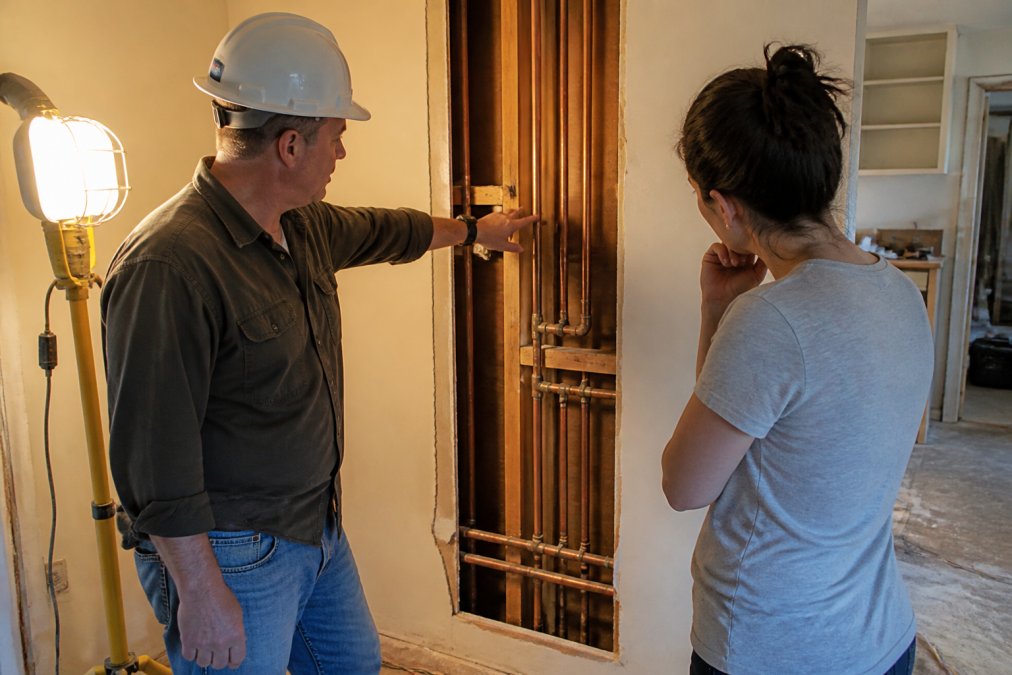
Permit Fees, Subcontractors, and Supply Chain Delays
Permit fees vary widely by jurisdiction and project scope. A kitchen remodel might require a building permit, an electrical permit, and a plumbing permit, each with its own fee and inspection schedule. Skipping permits isn’t a budget strategy; it’s a liability that can complicate a future home sale or insurance claim.
Subcontractors, electricians, plumbers, HVAC technicians, are specialists typically hired by your general contractor. Subcontractor scheduling drives your renovation timeline as much as the general contractor does. Delays in one trade cascade through the whole project.
Supply chain delays remain a real factor in 2026. Material procurement lead times for custom cabinetry, specialty tile, and certain appliances can run 8-16 weeks. Order materials early and lock in pricing.
Other hidden costs worth budgeting for explicitly:
- Temporary housing or storage if the renovation displaces a primary living area
- Debris removal and dumpster rental
- Utility reconnection fees after plumbing or electrical work
- Touch-up painting and punch-list work at project close
- Post-renovation maintenance costs on new systems
Never assume your contractor’s quote includes debris removal and dumpster costs. This is one of the most common line items added as a change order mid-project. Confirm it in writing before signing.
Use a Renovation Budget Spreadsheet Template to Track Every Dollar
A renovation budget spreadsheet template is a structured document that tracks projected costs, actual costs, and variance for every line item in your renovation project. It’s the operational tool that turns your budget from a plan into a living record.
The most effective renovation budget spreadsheet template includes these columns:
- Cost category and line item description
- Contractor or vendor name
- Estimated cost
- Actual cost paid to date
- Remaining balance
- Status (not started / in progress / complete / paid)
- Notes field for change orders or substitutions
Update it weekly, at minimum. The spreadsheet only works if it reflects current reality.
The Consumer Financial Protection Bureau’s home improvement resources recommends maintaining detailed records of all contractor payments, which a running spreadsheet supports directly. It also protects you in any dispute over what was agreed and what was paid.
After every contractor payment, update the spreadsheet the same day. This takes five minutes and prevents the slow drift where "we’re probably fine" becomes "we’re $12,000 over budget."
A renovation budget spreadsheet isn’t just a tracking tool. It’s your early warning system. When actual costs start diverging from estimates in one category, you can reallocate from another before the gap becomes a crisis.
Best Ways to Finance Home Renovations in 2026
Financing options for home improvements have expanded considerably, and the right choice depends on your equity position, credit profile, and project timeline.
The most common financing options for home renovations:
Home equity line of credit (HELOC): Draws against your home equity and typically offers lower interest rates than unsecured products. Best for larger projects where costs are spread over time.
Home equity loan: A fixed-rate lump sum secured against your home equity. Good for projects with a known, fixed total cost.
Cash-out refinance: Replaces your existing mortgage with a larger one, with the difference paid out as cash. Works best when current mortgage rates are favorable relative to your existing rate.
Personal loan: Unsecured, faster to obtain, but carries higher interest rates. More appropriate for smaller cosmetic projects.
FHA 203(k) rehabilitation loan: A government-backed loan that bundles the purchase price and renovation costs into a single mortgage. Useful for buyers purchasing a home that needs significant work. Details are available through the U.S. Department of Housing and Urban Development.
The financing decision should be made before you finalize your budget. The cost of capital affects your total project cost and how aggressively you should pursue your contingency fund.
Step 3: Manage Your Home Renovation Budget Through the Build
Managing a home renovation budget doesn’t end when construction starts. The build phase is where budgets actually live or die, and it requires consistent, structured communication with your contractor.
Controlling Change Orders and Scope Creep
A change order is a formal written modification to the original project scope, typically adding cost and time. Scope creep is what happens when changes accumulate informally, without documentation, until the project has grown well beyond its original parameters.
Every change to the project, materials substitution, added work, design revision, should be documented as a written change order before work proceeds. This protects both the homeowner and the contractor.
Practical rules for managing change orders:
- Require all changes in writing before approving additional work
- Confirm the cost and time impact of each change order before signing
- Update your budget spreadsheet immediately when a change order is approved
- Track cumulative change order total as a percentage of your original budget; if it exceeds 10%, reassess project scope
Tax Implications, Rebates, and Post-Renovation Costs
Home renovation costs are generally not deductible as personal expenses. However, capital improvements, work that adds value, extends useful life, or adapts a home to new uses, increase your cost basis. A higher cost basis reduces your capital gains exposure when you sell. Keep all contractor invoices and permits permanently.
Energy efficiency rebates: The Inflation Reduction Act created federal tax credits for certain energy-efficient home improvements, including heat pumps, insulation, and windows. Current credit amounts and eligibility requirements are updated annually through the IRS Energy Efficient Home Improvement Credit guidance.
Post-renovation maintenance costs: A new kitchen or primary suite comes with new maintenance obligations. Budget roughly 1% of the renovation cost annually for the first three years.
Psychological budgeting: Front-load your material and finish selections before construction starts. Locking in choices early reduces change orders, compresses your timeline, and keeps you from spending more on upgrades mid-project when your resistance is lowest.
Managing a home renovation budget from initial estimate through final punch list requires clear planning, consistent tracking, and a contractor who communicates proactively. Crosspoint Contracting brings 16 years of renovation experience, real-time project updates through Projul technology, and single-point accountability, you work directly with the owner from first conversation through final walkthrough. Get a Free Quote and see what a well-managed renovation actually looks like.
Frequently Asked Questions
How much contingency fund should I set aside for a remodel?
Most renovation professionals recommend reserving 10% to 20% of your total project budget as a contingency fund. For older homes with aging plumbing, electrical, or structural unknowns, lean toward 20%. This emergency reserve covers unexpected costs like rotted subfloor, outdated wiring that must be brought up to code, or supply chain delays that force material substitutions. Treating this fund as a non-negotiable line item from day one prevents budget overruns from derailing your project.
What are the most common hidden costs in home renovations?
The hidden costs of home remodeling most often include permit fees, demolition disposal, subcontractor markups, and code-compliance upgrades discovered once walls open up. Lead or asbestos remediation in pre-1980s homes, structural reinforcement, and temporary housing if you're displaced also catch homeowners off guard. Post-renovation costs like new furniture to match an upgraded space, higher utility bills from added square footage, and ongoing maintenance on new systems are frequently overlooked during the initial budget allocation.
What is the smartest way to finance a home renovation?
The best ways to finance home renovations depend on your equity position and credit profile. A home equity line of credit (HELOC) offers flexible draws and lower interest rates than personal loans because your home secures the debt. Home equity loans provide a fixed-price lump sum, which suits large, defined projects. FHA 203(k) loans bundle purchase and renovation financing into one mortgage. Cash is always the lowest-cost option when available. Talk to a licensed lender before committing, since interest costs directly affect your true project budget.
How do I prioritize renovation projects when on a budget?
Start with structural improvements and systems that protect the home: roof, foundation, HVAC, plumbing, and electrical. These affect safety, insurability, and long-term market value. Next, focus on capital improvements with strong return on investment, such as kitchen remodels and primary suite upgrades, which consistently rank highest in home appraisal impact. Cosmetic updates like paint and fixtures come last. If you're planning a whole home remodeling project, a contractor can help you sequence work to avoid redoing completed phases.
This article was written using GrandRanker