


Table of Contents
- Why Hiring the Right Contractors in Surprise AZ Matters More Than Ever
- How to Verify a Contractor’s Arizona Registrar of Contractors License Lookup
- Questions to Ask a General Contractor Before Hiring
- Understanding the Residential Remodeling Project Timeline
- Permitting and HOA Compliance for Surprise AZ Home Projects
- Cost Estimation and Budget Protection When Hiring Contractors in Surprise AZ
- Red Flags, Vetting Checklist, and Seasonal Maintenance After the Build
- Frequently Asked Questions
Last Updated: September 23, 2026
Why Hiring the Right Contractors in Surprise AZ Matters More Than Ever
Hiring the wrong contractor is the most expensive mistake a homeowner can make. Finding reliable contractors in Surprise AZ starts with one non-negotiable step: verifying credentials before you sign.
How to Verify a Contractor’s Arizona Registrar of Contractors License Lookup
The Arizona Registrar of Contractors license lookup is the fastest way to confirm a contractor is legally allowed to work in the state. Every legitimate builder holds an active license number, and the database shows it in seconds.
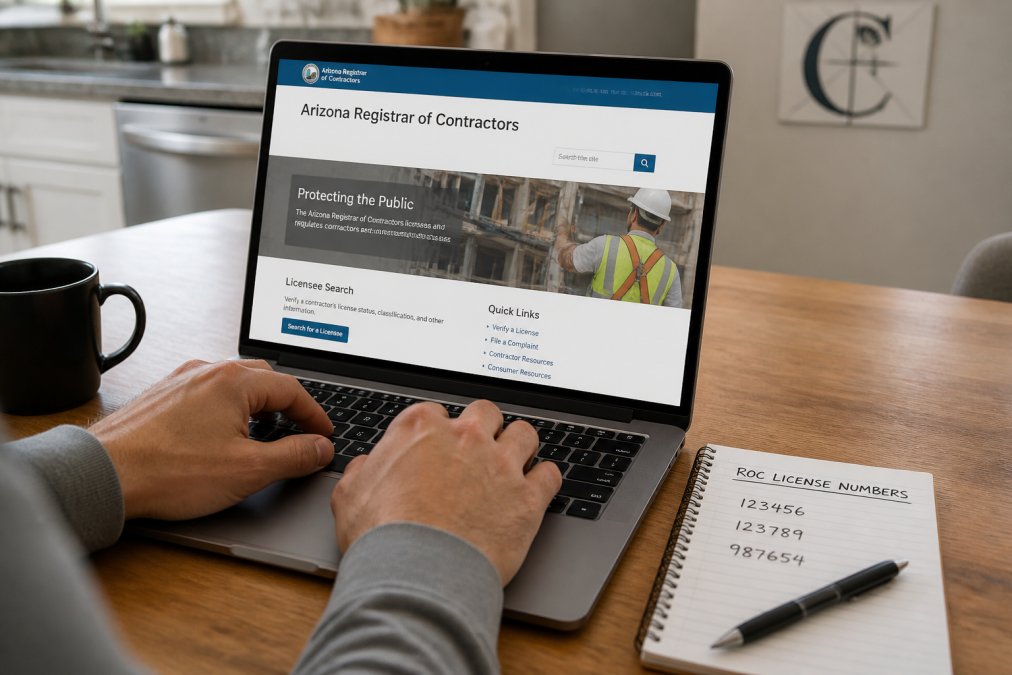
What the ROC License Lookup Reveals (and What It Hides)
The lookup confirms whether a license is active, what work it covers, and whether the contractor carries the right classification. A residential remodeling license doesn’t cover commercial build-outs, and vice versa. Crosspoint Contracting holds both a Residential ROC 263190 and a Commercial ROC 283814.
Checking Complaint History and Bonding Status
The same ROC portal lists complaint history and bonding status. A few resolved complaints over a decade is normal; a pattern of unresolved complaints is a warning.
Hiring an unlicensed contractor in Arizona can void your ability to file a complaint with the Registrar of Contractors and may leave you without recourse if the work fails. Always verify the license is active on the day you sign.
::: Beyond checking the license status, you must also verify contractor insurance to ensure that any potential property damage or workplace injuries are fully covered by a valid policy.
Questions to Ask a General Contractor Before Hiring
The best questions to ask a general contractor before hiring reveal how they handle problems, not just how they sell. Anyone can quote a price; fewer can explain what happens when the job hits a snag.
The Six Questions That Separate Professionals from Pretenders
Ask these before you sign:
- Who is my single point of contact? If the answer is “a project manager,” ask how often that person changes.
- How do you handle mid-project structural surprises? A 1970s home often hides plumbing and electrical quirks behind the walls.
- What’s your change-order process? You want it in writing, with costs approved before work continues.
- How do you communicate progress? Daily updates beat a weekly phone call.
- What’s your payment schedule? Large upfront deposits are a red flag.
- Can I speak to a recent client? Not a testimonial page. An actual phone call.
At Crosspoint Contracting, clients work directly with the owner from first meeting to final walkthrough. As customer Shannon Nevin put it, “Cliff swooped in like a knight in shining armor saving me from certain, inevitable disaster on my commercial build-out.”
Understanding the Residential Remodeling Project Timeline
A residential remodeling project timeline typically runs from four weeks for a bathroom to several months for a whole-house renovation, with consistent phases even when the calendar shifts.
Typical Phases from Contract Signing to Final Walkthrough
| Phase | What Happens | Typical Duration |
|---|---|---|
| Design and permitting | Drawings, selections, permit submission | 3-8 weeks |
| Demolition | Tear-out, dumpster, protection of adjacent rooms | 1-2 weeks |
| Rough-in | Framing, plumbing, electrical, HVAC | 2-4 weeks |
| Inspection | Municipal sign-off before walls close | 2-5 days |
| Finishes | Drywall, paint, tile, cabinetry, fixtures | 4-10 weeks |
| Final walkthrough | Punch list, cleanup, handover | 2-5 days |
Permits are the wild card. A simple kitchen permit may clear in days. A structural addition can take weeks. Build that buffer into your expectations.
Ask your contractor to submit permit applications before demolition starts. On many projects, that single scheduling move saves two to three weeks of idle time.
Permitting and HOA Compliance for Surprise AZ Home Projects
Permitting and HOA compliance trip up more projects than construction problems do. Most neighborhoods here fall under an HOA whose rules run on their own timeline, separate from the city’s review clock. Treat them as two separate approvals.
The Municipal Permit Path, Step by Step
Residential permits are issued through the city’s Community Development Department, which handles building safety, plan review, and inspections:
- Pre-application check. Confirm zoning and any overlay or design standards before spending money on drawings.
- Plan submittal. Deliver construction documents, a site plan, and a scope narrative. Structural, electrical, plumbing, and mechanical changes each carry their own review.
- Plan review. Reviewers approve, approve with comments, or return the set for corrections. Simple interior remodels often clear in days; additions and structural work take longer and may need a second round.
- Permit issuance. Fees are calculated from valuation and scope; once paid, the permit card is posted on site.
- Inspections. Scheduled in phases, foundation or rough framing, rough-in for electrical, plumbing, and mechanical, insulation, then final. Walls cannot be closed until rough-in passes.
- Certificate of occupancy or final sign-off. For additions and structural work, this closes the permit.
HOA Architectural Review Runs on Its Own Clock
Pull your HOA’s architectural guidelines before finalizing drawings. Many associations restrict exterior materials, paint colors, roof profiles, solar panel placement, and block wall height. Violating those rules means rejection and a restart, and HOA review often takes longer than the city’s plan review.
- Front-facing changes get the most scrutiny. Roof profile, garage door style, and paint color are the most common rejection points.
- Setbacks and wall heights are measured, not eyeballed. Get the numbers from your plat and your HOA docs, not from what a neighbor did.
- Approval is usually conditional. Many HOAs approve a project subject to matching the neighborhood palette or using a specific material, so read the approval letter carefully before ordering.
Sequence Matters
Sequence matters: HOA approval first, city permit second, demolition third. Reversing that order is the most common cause of stalled projects, and the most expensive, because it strands a signed contract and a demo crew with nothing to do.
What to Have Ready Before You Submit
A clean submittal moves faster than a corrected one. Before your contractor files, confirm you have:
- A signed contract and scope of work
- Stamped or sealed drawings if required
- A site plan showing the work area and setbacks
- The HOA architectural approval letter, if applicable
- Proof of the contractor’s active license and bonding
Cost Estimation and Budget Protection When Hiring Contractors in Surprise AZ
Budget protection starts with a detailed, line-item estimate, not a lump sum. When you hire contractors in Surprise AZ, insist every cost is broken out by trade and material, but a line-item estimate is only useful if you know what the numbers should roughly look like.
What Actually Drives the Price
Every residential remodel quote is built from the same cost drivers. Knowing them separates a lean bid from a lowball:
- Scope and square footage. A bathroom, kitchen, and whole-house renovation are priced very differently; finished square footage is a significant factor.
- Whether walls move. Cosmetic updates, paint, flooring, fixtures, sit at the low end. Relocating plumbing, electrical, or load-bearing structure jumps a tier.
- Material tier. Builder-grade, mid-range, and custom finishes can swing a kitchen or bath budget widely, even when labor is identical.
- Age and condition. Older homes hide galvanized plumbing, aluminum wiring, and undersized framing. A responsible estimate carries a contingency line for this.
- Permit and inspection overhead. Structural work, additions, and anything touching electrical or plumbing pulls in plan review and phased inspections, adding fees and calendar time.
How to Read a Line-Item Estimate
A proper estimate lists labor, materials, permits, and a contingency line, separated by trade. Check for these things:
- Labor and material broken out separately. A blended number hides where the money goes.
- Permits and fees itemized. They are not free, and not the contractor’s problem to absorb silently.
- A contingency line. Contingency isn’t padding; it absorbs surprises. A rock-bottom quote with no contingency is either guessing or planning to bill you later.
- Allowances labeled. If the estimate says ’tile allowance,’ ask what happens when your selection exceeds it. That gap is where budgets quietly die.
- Payment schedule tied to milestones. Progress payments should follow completed phases, not calendar dates.
Scope Creep Is the Silent Budget Killer
Each change feels small in the moment: upgraded tile here, a moved outlet there. Stacked over a three-month build, they can blow past your original number. The fix is procedural:
- Approve every change order in writing before work continues.
- Ask for the cost delta, not just the description, on every change.
- Track spending against the budget weekly, not at the end.
- Keep a running contingency balance so you know how much buffer is left.
Never approve verbal change orders. If the scope shifts, get the cost in writing before work proceeds. Verbal agreements are the leading cause of end-of-project disputes.
Real-Time Cost Visibility Beats a Surprise Invoice
Crosspoint Contracting manages costs through Projul, a project management platform that tracks every line item in real time, so clients see the budget as it moves. As Kathy Robinett noted after her remodel, “Cliff was upfront on price quotes and kept us abreast of the progress.”
Red Flags, Vetting Checklist, and Seasonal Maintenance After the Build
Red flags cluster around the same behaviors: a contractor who demands a large upfront deposit, avoids written contracts, can’t produce a license number, or pressures you to sign “today only” is telling you something.
Use this vetting checklist before you commit:
- Verified active ROC license number
- Confirmed bonding and liability insurance
- Reviewed complaint history on the state portal
- Received a written, line-item estimate
- Confirmed a single point of contact
- Spoke with at least two recent clients
- Reviewed the change-order process in writing
- Confirmed the payment schedule ties to milestones, not calendar dates
Frequently Asked Questions
How do I verify if a contractor is licensed with the Arizona Registrar of Contractors?
Go to the Arizona Registrar of Contractors website and enter the contractor’s license number or business name in the search tool. The lookup shows license status, classification, bond information, and any complaint history. Crosspoint Contracting holds Residential ROC 263190 and Commercial ROC 283814. Always verify before signing anything, and confirm the license classification matches your project type, whether that’s a kitchen remodel or a tenant improvement.
What questions should I ask a general contractor before hiring them?
Ask who will be on site daily, how change orders are priced, what the payment schedule looks like, and whether the owner is directly involved or hands you to a project manager. Request proof of insurance and bonding. Ask for references from projects similar to yours. A contractor who answers clearly and provides documentation is worth your time. One who dodges specifics is not.
How long does a residential remodeling project timeline typically run?
A kitchen remodel usually takes several weeks once permits are approved. A primary suite or whole-house renovation runs several months depending on scope. Additions can take longer. Permit approval alone can add several weeks in Surprise. Ask your contractor for a phase-by-phase schedule before signing, not just a completion date.
What should I do if my contractor finds unexpected structural or plumbing issues mid-project?
A transparent contractor documents the issue with photos, explains what caused it, and provides a written change order with itemized costs before doing any extra work. You approve or decline. If a contractor demands additional money without documentation or pressure to decide on the spot, that is a red flag. Ask upfront how they handle surprises so there is no ambiguity later.