


Table of Contents
- Why Home Improvement in Phoenix Demands a Different Approach
- ROC-Licensed General Contractors: What the License Actually Covers
- How to Vet a Residential Contractor Before You Sign Anything
- Average Cost of Kitchen Remodel in Phoenix and What Drives the Number
- Hiring a Contractor vs Project Manager: Who Actually Runs Your Build
- Permitting, Zoning, and Building Codes in Phoenix
- Climate-Resilient Materials and Energy-Efficient Upgrades That Pay Off
- Frequently Asked Questions
Last Updated: September 15, 2026
Why Home Improvement in Phoenix Demands a Different Approach
Home improvement in Phoenix is not the same game as in milder climates, and treating it as a generic renovation wastes money. At Crosspoint Contracting, we have remodeled homes and commercial spaces across the Valley for 16 years, and the same pattern shows up on nearly every job: materials and methods that work elsewhere fail here within a few seasons.
Summer surface temperatures push past 110°F, and the swing between a July afternoon and a January morning can exceed 50 degrees. That swing breaks cheap materials: wood cabinets swell and shrink, inferior caulk cracks, and standard exterior paint chalks and fades in two summers instead of ten.
The desert also punishes the inside of your home. West-facing rooms take on heat all afternoon, and an under-insulated attic turns your HVAC into the hardest-working appliance you own.
This guide covers what actually matters when you renovate here: licensing, vetting, cost drivers, permitting, and the material choices that hold up.
ROC-Licensed General Contractors: What the License Actually Covers
An ROC license is the baseline requirement for any contractor working in Arizona, and it is not a formality. The Arizona Registrar of Contractors issues residential and commercial licenses separately, and holding one does not authorize the other.
A residential license covers homes and residential structures; a commercial license covers tenant improvements, office build-outs, and retail or restaurant spaces. Hire a residential-only contractor for a commercial build-out and you have a compliance problem.
Crosspoint Contracting holds both: Residential ROC 263190 and Commercial ROC 283814. That dual licensing is uncommon among smaller Valley firms, and it means one accountable team can handle a primary suite remodel and a medical office renovation without subcontracting the license.
Here is what the license does and does not cover:
| License Type | Covers | Does Not Cover |
|---|---|---|
| Residential ROC | Homes, additions, kitchen and bath remodels | Commercial tenant improvements |
| Commercial ROC | Office, retail, restaurant, medical build-outs | Residential structures |
| Bonded and insured | Claims against defective or abandoned work | Work performed by unlicensed subs |
A license alone does not guarantee quality. It does guarantee recourse. The Arizona Registrar of Contractors complaint and recovery process exists precisely because unlicensed work leaves homeowners with almost no path to recover losses.
Hiring an unlicensed contractor voids most of your legal protection. If the work fails or the contractor walks off the job, you cannot file a Registrar complaint, and your homeowner’s insurance will typically deny the claim because the work was never permitted.
How to Vet a Residential Contractor Before You Sign Anything
Vetting a residential contractor comes down to three verifiable checks: license status, insurance and bonding, and a documented pricing structure. Skip any one and you are gambling with the largest single investment most homeowners make.
Start with the license number. Every ROC-licensed contractor has a public record showing license status, classification, and complaint history. Ask for the number in writing, then verify it yourself rather than trusting a logo on a truck.
Next, request a certificate of insurance and confirm the bond is active. General liability protects your property if a worker damages it; a bond gives you a claim path if the contractor abandons the job.
Then examine how they price. A common mistake is accepting a verbal estimate and a handshake. Ask for a written scope with line items, an explicit allowance schedule, and a stated change-order process. Contractors who resist putting scope in writing are telling you something.
- License number verified on the state registry
- Certificate of insurance dated within the last 12 months
- Active bond confirmed
- Written scope with line-item pricing
- Change-order process documented in the contract
- Payment schedule tied to completed milestones, not calendar dates
- At least three recent local references you can call
Ask every reference the same question: “Did the final invoice match the original quote, and if not, what changed?” The answer tells you more about a contractor’s cost discipline than any review score.
Average Cost of Kitchen Remodel in Phoenix and What Drives the Number
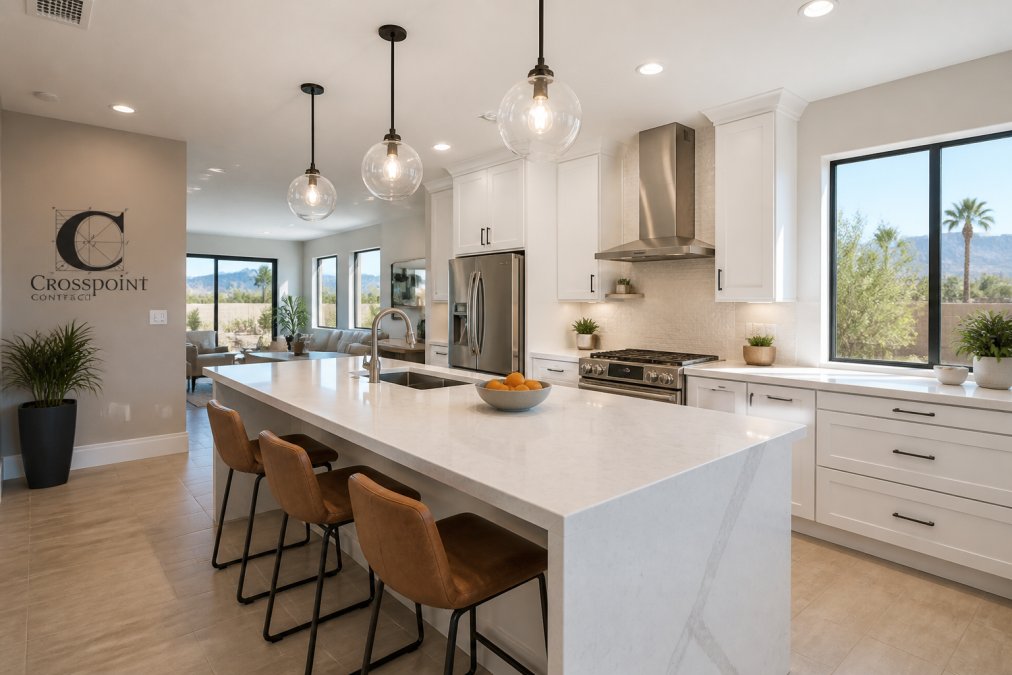
There is no single average cost of kitchen remodel that applies to every home, because the number is driven by scope, not square footage. Two identical-size kitchens can differ by tens of thousands of dollars depending on whether walls move, whether plumbing relocates, and what finishes you select.
What actually moves the total:
- Layout changes. Removing a wall or relocating a sink means new plumbing and electrical runs, plus structural work if the wall is load-bearing.
- Cabinet grade. Custom cabinetry is priced per linear foot and varies widely by material, finish, and hardware.
- Countertop material. Quartz, granite, and solid surface carry different fabrication and installation costs.
- Appliance package. Built-in and panel-ready appliances cost more to install than freestanding units.
- Permit and inspection fees. Required for structural, electrical, and plumbing changes.
Because pricing depends on scope, materials, and site conditions, we quote every project individually rather than publishing a flat rate. A written, fixed-pricing estimate after a site walk is the only number worth planning around.
The biggest driver of a kitchen budget is not the finishes you can see. It is the plumbing, electrical, and structural work behind the walls. Get those scoped first, then choose finishes with what remains.
Hiring a Contractor vs Project Manager: Who Actually Runs Your Build
Hiring a contractor versus a project manager is a distinction most homeowners never make, and it is why so many projects stall. A project manager coordinates schedules and trades; a licensed general contractor carries legal responsibility for the work, the permits, and the outcome. Securing a professional who understands this legal distinction ensures that the structural integrity of your renovation remains a reliable foundation for increasing home value.
You can hire a project manager with no license and no liability, or a contractor who subcontracts everything and shows up twice. Neither gives you one person who owns the result.
The design-build model solves this by keeping design, permitting, and construction under one contract. With a single point of accountability, there is no finger-pointing between the designer who drew it and the builder who has to construct it.
That is how Crosspoint Contracting operates, deliberately. We stay small so you work directly with the owner, not a rotating cast of project managers. Real-time updates run through Projul technology, so you can see schedule and cost status without being on site daily, and same-day communication is the standard.
If you are coming from a traditional design-bid-build arrangement, expect a different rhythm. Fewer change-order surprises, faster decisions, and one phone number.
Permitting, Zoning, and Building Codes in Phoenix
Permits are not optional paperwork, and skipping them creates problems that surface at resale.
| Layer | What It Governs | Who Enforces It |
|---|---|---|
| Building code | Egress, fire separation, structural loads, energy requirements | City or county building safety division |
| Zoning ordinance | Setbacks, lot coverage, height limits, ADU eligibility, parking | City or county planning department |
| HOA / CC&Rs | Paint color, roof material, front-yard hardscape, visible equipment, addition massing | Private homeowners association |
| Historic or overlay district | Exterior alterations, demolition, window and door profiles | Design review board |
What Actually Triggers a Permit
The ADU and Addition Path
HOA Approvals Run on a Separate Clock
Unpermitted work discovered during a sale can stall your closing or force you to tear out completed construction. The cost of retroactive permitting almost always exceeds the cost of doing it correctly the first time, and an open permit from a prior owner can block your own approvals until it is closed.
Ask your contractor for the permit number and the inspection schedule before demolition starts. If they cannot produce a permit number, the work is not permitted, regardless of what the contract says.
Climate-Resilient Materials and Energy-Efficient Upgrades That Pay Off
What Holds Up Here
Energy-Efficient Upgrades and What They Actually Do
Where the Money Actually Goes
In this climate, the highest-return upgrades are the ones you cannot see: air sealing, attic and duct insulation, and low-E glass on west and south exposures. Choose those first, then spend what remains on finishes.
Frequently Asked Questions
How do I verify a contractor’s ROC license in Arizona?
Go to the Arizona Registrar of Contractors website and search by license number or company name. Check that the license is active, the entity name matches your contract, and the license class covers your project type. Residential work requires a residential license; commercial build-outs need a commercial one. Crosspoint Contracting holds Residential ROC 263190 and Commercial ROC 283814. Ask for a certificate of insurance and a bonding letter at the same time.
What is the average cost of a kitchen remodel in Phoenix?
Kitchen renovation pricing depends on square footage, cabinet grade, countertop material, layout changes, and whether plumbing or electrical must move. A cosmetic refresh costs far less than a full gut with relocated walls. Because every scope is different, ask for a fixed-pricing proposal tied to a defined scope rather than a per-square-foot estimate. Crosspoint Contracting provides free estimates with line-item detail so you can see exactly where the money goes.
What should I look for when vetting a local general contractor?
Verify the ROC license, confirm active insurance and bonding, and ask who will be on site daily. Request three local references from projects similar to yours and actually call them. Read the contract for scope, payment schedule, change-order process, and completion dates. A contractor who answers questions about permits, inspections, and warranty terms without hesitation is usually the one who manages projects well.
How do I avoid common pitfalls during a home improvement project?
Lock the scope before demolition starts. Get every change in writing with a cost and timeline impact. Set a contingency fund for hidden issues, especially in older homes with outdated plumbing or electrical. Ask for weekly progress updates and a single point of contact. Crosspoint Contracting uses Projul to send real-time updates so homeowners are not chasing the crew for status.