


Table of Contents
- What a General Contractor Actually Does in Construction
- How to Verify ROC License and Insurance Before You Sign
- General Contractor Interview Questions That Reveal the Truth
- Red Flags When Hiring a Contractor for Construction Work
- Residential Construction Project Timeline: What to Expect
- Commercial vs. Residential Construction: Key Differences
- Vetting and Selection Criteria for General Contractors
- Frequently Asked Questions
Last Updated: September 30, 2026
What a General Contractor Actually Does in Construction
A general contractor is the person or firm that takes legal and practical responsibility for delivering a construction project, from cost estimation through final walkthrough. Hiring the right one is the difference between a renovation that finishes on schedule and one that drains your savings. This guide from Crosspoint Contracting breaks down how to verify credentials, interview candidates, and spot trouble before you sign.
Core Responsibilities: From Cost Estimation to Quality Assurance
A general contractor’s job spans the full project lifecycle:
- Cost estimation and procurement, building the budget, sourcing materials, and locking in subcontractor bids
- Permitting and building codes, filing with the local authority and keeping work compliant
- Site supervision and field operations, daily oversight of trades, sequencing, and safety compliance
- Quality assurance and risk management, inspecting work, catching defects early, and carrying liability insurance
- Contract administration, managing change orders, payment schedules, and closeout documents
What most guides miss is how much of this is invisible to the client. The best GCs absorb problems before you hear about them.
How a GC Differs from a Subcontractor or Project Manager
A subcontractor performs one trade. A project manager coordinates schedules. A general contractor does both jobs and carries the legal and financial risk if either fails.
If your contract names a project manager as your main contact but the GC holds the license, confirm in writing who carries liability. That single sentence prevents most disputes.
How to Verify ROC License and Insurance Before You Sign
Verifying a contractor’s license takes about ten minutes and prevents the most expensive mistake in construction. In Arizona, the Registrar of Contractors (ROC) maintains a public database where you can search any license number, confirm it’s active, and review complaint history.
Here’s the verification checklist:
- Look up the license number on the Arizona Registrar of Contractors license search
- Confirm the license class matches your project type (residential vs. commercial)
- Check for active complaints or disciplinary actions
- Request a certificate of insurance showing general liability coverage
- Ask for a surety bond document and confirm the bond amount
- Verify the business name on the license matches your contract
General Contractor Interview Questions That Reveal the Truth
The right interview questions separate a polished sales pitch from a contractor who actually runs tight projects. Ask these before you discuss price.
Questions About Pricing, Scope, and Change Orders
- How do you structure your pricing, and what’s included in the bid?
- What’s your process when a hidden issue surfaces mid-project?
- How do you document and approve change orders?
- What’s your policy on allowances, and what happens if we exceed them?
Listen for specifics. A contractor who says “we’ll figure it out” on change orders will figure it out in their favor.
Questions About Communication and On-Site Presence
- Who is my daily point of contact, and how fast do they respond?
- How often will I get progress updates, and in what format?
- Will the owner be on-site, or will I work with a rotating project manager?
- How do you handle scheduling conflicts between trades?
Ask for the name of the last three clients whose projects hit a snag. How a contractor handled a problem tells you more than how they handled a smooth build.
Red Flags When Hiring a Contractor for Construction Work
Certain warning signs should end the conversation immediately. These aren’t minor annoyances; they’re predictors of disputes, liens, and unfinished work.
- Large deposit requests upfront, legitimate contractors bill in draws tied to completed milestones
- No physical business address, a P.O. box and a cell number is not a business
- Verbal-only agreements, every scope, price, and change belongs in writing
- Pressure to sign today, real contractors have backlogs and don’t need to rush you
- Cash-only payment demands, this removes your paper trail and often signals unlicensed work
- Vague timelines, “a few months” is not a schedule
- Reluctance to provide references, a contractor with 16 years of work should have plenty
Residential Construction Project Timeline: What to Expect
A residential renovation typically moves through five phases: design and permitting, demolition, rough-in, finishes, and final inspection. Timelines vary with scope, but the sequence rarely changes, and the payment schedule should track that sequence rather than the calendar.
| Phase | Typical Duration | What Happens | Typical Draw |
|---|---|---|---|
| Design and permitting | 4-8 weeks | Drawings, selections, permit approval | Deposit (10-15%) |
| Demolition | 1-2 weeks | Tear-out, dumpster, structural assessment | Second draw |
| Rough-in | 2-4 weeks | Framing, electrical, plumbing, HVAC | Third draw |
| Finishes | 4-8 weeks | Drywall, tile, cabinetry, paint, fixtures | Fourth draw |
| Final inspection | 1-2 weeks | Punch list, inspections, certificate of occupancy | Final retainage (5-10%) |
How the Timeline Connects to Your Payment Schedule
The phase table above is also a payment map. Most residential contracts bill in draws tied to completed milestones, not to dates on a calendar. A common pattern is a deposit of 10-15% at signing, a draw at rough-in inspection, a draw at drywall completion, and a final retainage of 5-10% held until the punch list closes.
Two mechanics protect you here:
- Retainage. Holding back the final 5-10% gives you leverage to get punch-list items finished. Contractors expect this on larger jobs; a contractor who refuses retainage entirely is a warning sign.
- Lien waivers. Before each draw, ask for a conditional lien waiver from the GC and its major subs. This confirms the trades that worked on your home have been paid, which prevents a mechanic’s lien from landing on your title after you’ve written the final check.
Never pay a draw ahead of the work it covers. If a contractor asks for the finishes draw before rough-in is inspected, you’ve lost your only leverage to get the work corrected.
What Actually Moves the Timeline
Three variables drive most schedule slips, and none of them are the contractor’s speed on the tools:
- Permit review. Municipal review times swing widely by jurisdiction and by project type. A structural change or an addition can add weeks to the front end before a shovel touches the ground.
- Selections and lead times. Cabinetry, windows, and specialty fixtures can carry lead times measured in months. Late selections stall the finishes phase even when the crew is ready.
- Change orders. Each approved change resets sequencing. A mid-project scope change during rough-in can push every downstream trade.
Fixed-Price vs. Cost-Plus: How the Contract Changes the Timeline
The contract type you sign changes how the timeline and budget interact, and this is where most financial disputes start:
- Fixed-price (lump-sum). The contractor commits to a total price for a defined scope. You get budget certainty, but changes are priced individually and can be expensive. Best when the scope is fully designed before signing.
- Cost-plus. You pay actual material and labor costs plus an agreed markup (often a percentage or a fixed fee). This is common on renovations where hidden conditions are likely, but it puts the budget risk on you. Insist on an open-book accounting clause and a guaranteed maximum price if you go this route.
Commercial vs. Residential Construction: Key Differences
Commercial construction carries stricter code requirements, longer permitting cycles, and different insurance thresholds than residential work. A contractor licensed for one is not automatically qualified for the other, and the gap shows up in four places: code, insurance, bonding, and contract structure.
Code and Occupancy
Commercial projects involve ADA compliance, fire suppression systems, and occupancy classifications that don’t apply to a kitchen remodel. Tenant improvements for a retail or medical space require coordination with the landlord, the fire marshal, and sometimes the health department. Residential work focuses on structural integrity, energy code, and habitability.
Insurance and Bonding Capacity
This is the difference most clients never check. A residential GC may carry general liability limits that are adequate for a home but far too low for a commercial build-out. Commercial projects commonly require higher general liability limits, a commercial auto policy, and workers’ compensation coverage that names the project. Surety bonding capacity matters too: a contractor’s ability to obtain a performance bond is a proxy for its financial strength, and many commercial owners require one.
Contract Structure and Risk Transfer
Commercial contracts are longer for a reason. They typically include:
- Indemnification clauses that shift liability for third-party claims to the contractor
- Liquidated damages that set a fixed dollar amount per day for late completion
- Payment and performance bonds that guarantee the work and the money
- Retainage terms that may run longer than residential norms
Hiring a residential-only contractor for a commercial build-out can void your certificate of occupancy and stall your opening. Confirm the license class and the insurance limits cover your project type before signing.
::: Specialized trade requirements extend beyond general oversight, as hiring professional plumbers for vintage homes often demands a deeper understanding of legacy piping systems and local building codes.
How to Tell Which Type You Actually Need
A simple test: if the space will be occupied by the public, employees, or tenants, or if the work triggers a change of occupancy classification, you’re in commercial territory. If it’s a single-family home you’ll live in, it’s residential. Mixed-use and live-work projects can straddle both, which is exactly when you want a GC who has delivered both and can show you the permits to prove it.
Vetting and Selection Criteria for General Contractors
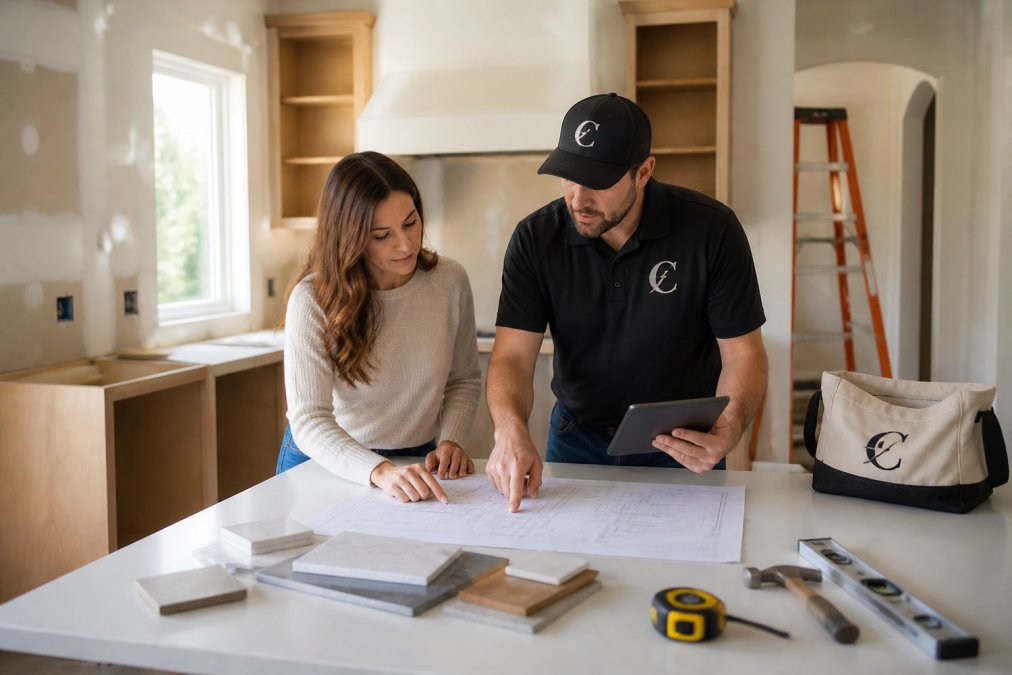
Score every candidate against the same criteria so the decision isn’t driven by personality. Use a weighted rubric: license and insurance status, relevant project experience, references, communication responsiveness, and clarity of the written estimate.
Frequently Asked Questions
What does a general contractor do in construction?
A general contractor oversees the entire construction project, from cost estimation and permitting to scheduling subcontractors and ensuring quality assurance. They manage the project lifecycle, coordinate vendors, and handle risk management. For a residential renovation, the GC is your single point of contact for everything from demolition to final walkthrough. Crosspoint Contracting uses a design-build approach so you work directly with the owner, not a rotating project manager.
How do I verify a general contractor’s ROC license?
In Arizona, you can verify a contractor’s ROC license through the Arizona Registrar of Contractors website. Look up the license number, check the status (active or suspended), and confirm the license class matches your project type, residential or commercial. Crosspoint Contracting holds Residential ROC 263190 and Commercial ROC 283814. Always ask for a copy of the license and verify it yourself before signing any contract.
What are common red flags when hiring a contractor?
Watch for demands for large upfront cash payments, no written contract, lack of a physical address or verifiable license, and pressure to sign quickly. Other red flags include unwillingness to provide references, evasive answers about insurance, and quotes that are significantly lower than others. Trust your gut: if a contractor avoids your questions about licensing, insurance, or timeline, walk away. Crosspoint Contracting is licensed, bonded, and insured, and provides transparent pricing.
How long does a residential construction project timeline take?
Timelines vary depending on the scope of work. Timelines depend on permit approvals, material lead times, and scope changes. A reliable general contractor provides a detailed schedule upfront and updates you on progress. Crosspoint Contracting uses Projul technology for real-time updates, keeping you informed without daily site visits.
Hiring a general contractor comes down to verification and fit. The license check takes minutes, the interview takes an hour, and both protect a project that costs far more than either. Crosspoint Contracting has remodeled homes and commercial spaces for 16 years, is ROC-licensed for both residential and commercial work, and keeps projects small on purpose so you work directly with the owner. Get a free quote and see what a stress-free build actually looks like.