


Table of Contents
- Why Finding the Right Contractor Determines Your Project’s Success
- Start with the Arizona Registrar of Contractors License Lookup
- Red Flags When Hiring a General Contractor
- Questions to Ask Home Renovation Contractors Before You Sign
- How a Design-Build Approach Keeps Your Renovation on Track
- Your Pre-Hire Checklist for a Reliable Home Renovation Contractor
- Finding a Home Renovation Contractor Who Stays Until the End
- Frequently Asked Questions
Last Updated: September 9, 2026
Choosing the wrong contractor is the fastest way to turn a dream renovation into a costly nightmare. When you need to find reliable home renovation contractor phoenix options, the stakes include your family’s daily routine, your budget, and the structural integrity of your largest asset. At Crosspoint Contracting, we have spent 16 years remodeling homes across the Phoenix Valley, and we have seen the fallout from poor hiring decisions firsthand. Below, we will show you exactly how to vet candidates, verify their credentials, and select a partner who finishes the job.
Why Finding the Right Contractor Determines Your Project’s Success
The contractor you hire dictates everything: material quality, timeline adherence, communication, and whether surprise costs derail your budget. A reliable home renovation contractor in Phoenix does more than swing a hammer; they orchestrate permits, coordinate subcontractors, and solve problems before they become expensive change orders.
Most renovation horror stories trace back to one of two failures: hiring an unlicensed operator or hiring a company that over-promises during the sales pitch. The Arizona construction market has specific licensing requirements for a reason, and skipping verification puts you at financial risk. A contractor who is not properly licensed and insured can leave you liable for injuries on your property or defective work that fails inspection. Your goal is not merely to find a contractor; your goal is to find a contractor who treats your home and budget with the same care you would.
Start with the Arizona Registrar of Contractors License Lookup
The first step in your search should always be the Arizona Registrar of Contractors (ROC) license lookup. This free, public database lets you confirm that a business holds an active license, shows the license classification, and reveals any history of complaints or disciplinary actions. According to the Arizona Registrar of Contractors official website, verifying a license is the single most effective way to filter out unqualified operators.
Search for the company name and the owner’s name, and write down the license number. A legitimate contractor will not hesitate to share this information. Residential work requires a license classification like B-1 (general contractor), while commercial projects need their own specific classification (azroc.gov). If a candidate cannot produce a valid license number, end the conversation immediately. This single step protects you from the majority of common contractor scams and ensures you are working with someone the state holds accountable. Crosspoint Contracting operates under Residential ROC 263190 and Commercial ROC 283814, which you can verify directly through the same portal.
Red Flags When Hiring a General Contractor
Spotting the warning signs early saves you from significant stress and financial loss. Several red flags should prompt you to walk away from a potential hire, no matter how persuasive the salesperson is.
A common mistake is accepting a bid that is dramatically lower than every other estimate. Lowball bids often indicate that the contractor plans to cut corners on materials or will hit you with change orders later to recover their margin. Another major warning sign is a demand for a large upfront deposit, particularly cash, before any work begins. Legitimate contractors typically structure payments around project milestones, not a single lump sum paid in advance.
What most guides miss is the importance of communication responsiveness. If a contractor takes several days to return your initial call, imagine how they will behave when a plumbing issue arises mid-project. Other red flags include refusing to provide proof of insurance, asking you to pull the permit yourself, and lacking a physical business address. A reliable home renovation contractor in Phoenix will have a professional office, a verifiable track record, and a willingness to put everything in writing. If you encounter a contractor who pressures you to sign immediately or discourages you from researching them, trust your instincts and continue your search.
Questions to Ask Home Renovation Contractors Before You Sign
Asking the right questions separates a confident professional from a smooth talker. Before you sign any agreement, schedule a detailed consultation and ask questions to home renovation contractors that reveal their true process and experience. vetting electrical professionals.
Start with the practical: “How long have you been operating in the Phoenix Valley?” and “Can you provide references from projects completed in the last year?” Follow up with questions about their workflow: “Who will be my daily point of contact?” and “How do you handle unexpected structural issues discovered mid-project?” The answers tell you whether you will work with the owner directly or get handed off to a rotating cast of project managers. For busy families, this distinction matters enormously; you want a single point of accountability.
Ask specifically about cost management: “How do you prevent scope creep from inflating my budget?” A contractor who practices proactive cost management will explain their change order process clearly and commit to communicating before any overage occurs. Also ask about communication tools: “How will you keep me updated on progress?” Modern firms use project management technology to provide real-time updates, a feature that eliminates the need for you to be on-site every day. Finally, request their license number and insurance certificate so you can verify coverage independently. A contractor who answers these questions directly and transparently is demonstrating the professionalism you need for a stress-free build.
How a Design-Build Approach Keeps Your Renovation on Track
The traditional model separates the designer from the builder, creating friction, delays, and budget disputes between parties who have different incentives. A design-build approach consolidates both roles under one contract, which keeps your renovation on track from the first sketch to the final walkthrough. This single-point accountability means one team owns the outcome, eliminating the classic “the architect blamed the contractor” blame game.
For a whole-house renovation or a complex kitchen remodel, this integration is particularly valuable. Design decisions that affect structural work, like moving a load-bearing wall or rerouting plumbing, are caught early when they are cheap to adjust, not during construction when they become expensive surprises. The design-build team also provides more accurate estimates because the builder is pricing the plans they helped create. When you need to find reliable home renovation contractor phoenix teams, prioritizing firms that offer design-build services reduces your administrative burden and gives you a genuine partner in the process. Crosspoint Contracting builds this way intentionally, ensuring the person designing your project is the same team accountable for delivering it on time and on budget.
Your Pre-Hire Checklist for a Reliable Home Renovation Contractor
Use this checklist to compare candidates objectively and avoid making a decision based on charm or price alone. Print it out and bring it to every consultation.
- Verify the company’s ROC license number on the Arizona Registrar of Contractors website
- Confirm the contractor is bonded and carries general liability and workers’ compensation insurance
- Request and contact at least three references from recent, similar projects
- Ask for a written, detailed bid that itemizes materials, labor, and allowances
- Confirm who will be your daily point of contact and how communication happens
- Ask how the firm handles change orders and unexpected structural findings
- Review the contract for a clear payment schedule tied to project milestones
- Confirm the contractor holds the appropriate license classification for your project type, residential or commercial
- Evaluate their process for providing real-time project updates
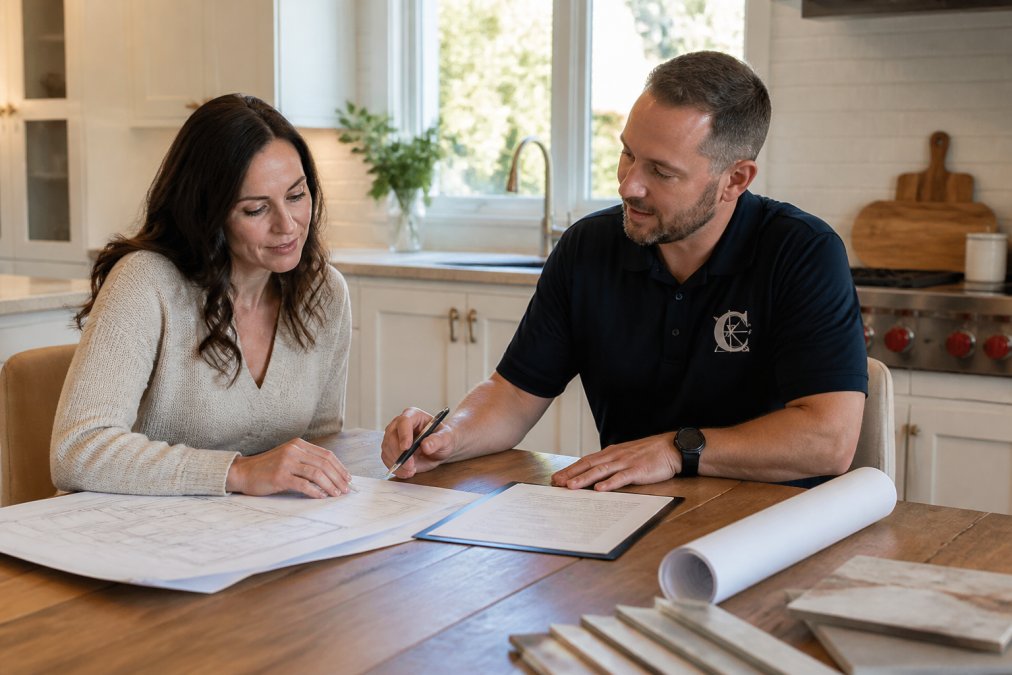
This checklist is your defense against the most common pitfalls, including vague bids, unlicensed operators, and communication breakdowns. A reliable home renovation contractor in Phoenix will welcome this level of scrutiny because they have nothing to hide. If a candidate hesitates to provide references or proof of insurance, mark them off your list and move on. Taking an hour to complete these steps protects you from months of potential headaches.
Finding a Home Renovation Contractor Who Stays Until the End
The true measure of a contractor is not how they handle the first week of a project, but how they finish. Finding a home renovation contractor who remains engaged through the final punch list is the difference between a renovation you love and one you tolerate. Before you sign, ask the contractor to walk you through their closeout process, including how they handle final inspections and warranty callbacks. The Arizona Registrar of Contractors provides resources on resolving construction disputes and understanding your rights, which is useful background knowledge even for a smooth project.
Look for evidence of long-term commitment in their track record. A company with 50+ five-star reviews and three decades of local experience demonstrates they have built a reputation worth protecting. Commercial clients, such as medical offices or retail store owners, should confirm the contractor has relevant experience beyond residential work, as commercial build-outs involve different codes and approval processes. The right contractor treats your project as a reflection of their own name, which means they will not disappear when the work gets difficult. They will communicate proactively, manage the budget transparently, and deliver the finished space you envisioned. When you have vetted candidates against this standard, you can proceed with confidence, knowing your project is in capable hands.
Finding a contractor who delivers on time, on budget, and without daily stress requires disciplined vetting. At Crosspoint Contracting, we have built our reputation on exactly this standard: working directly with the owner, providing real-time project updates through Projul technology, and maintaining transparent, same-day communication. Whether you are planning a kitchen remodel, a whole-home renovation, or a commercial tenant improvement, our ROC-licensed team is ready to handle the complexity for you. Get started with Crosspoint Contracting and take the first step toward a renovation that meets your expectations.
Frequently Asked Questions
How do I verify a contractor’s license with the Arizona Registrar of Contractors?
Use the Arizona Registrar of Contractors license lookup tool on their official website. Enter the contractor’s name or license number to confirm the license is active and in good standing. Check that the license classification matches your project type, whether residential or commercial. Also confirm the license holder’s name matches the person you are speaking with. This step takes five minutes and protects you from unlicensed work.
What questions should I ask a home renovation contractor before hiring?
Ask who will be on-site daily and who your main point of contact will be. Request examples of similar projects and references you can call. Ask how they handle unexpected issues like plumbing or electrical problems found mid-project. Clarify their payment schedule and how they manage change orders. Finally, ask how often you will receive project updates and through what method.
How can I tell if a contractor is reliable?
Reliable contractors have an active ROC license, carry insurance and bonding, and provide written contracts with detailed scopes of work. They respond to calls and emails promptly and communicate proactively about timelines and budgets. Check their review history on Google and the Better Business Bureau, but also ask for local references. A contractor who visits your home, takes measurements, and asks questions about your needs is more reliable than one who gives a quote over the phone.
What is the difference between a general contractor and a specialty contractor?
A general contractor oversees the entire renovation project, coordinating all trades like plumbing, electrical, and carpentry. They hold the main contract with you and carry the overall liability. A specialty contractor, such as an electrician or plumber, holds a license for their specific trade and typically works under the general contractor on a larger project. For a whole-home renovation or addition, a general contractor provides single-point accountability.