


Table of Contents
- What to Look for in Commercial General Contractors Near Me
- How to Vet a Commercial Contractor Before You Sign
- Commercial Construction Cost Per Square Foot: What Drives Your Budget
- Permitting and Zoning Navigation for Commercial Projects
- Tenant Improvement Project Management: From Design to Closeout
- Sustainability and LEED Certification in Commercial Construction
- Conclusion
- Frequently Asked Questions
Last Updated: September 13, 2026
What to Look for in Commercial General Contractors Near Me
Finding reliable commercial general contractors near me starts with three verifiable documents: a state contractor license, active bonding, and current liability and workers’ compensation insurance. In Arizona, the Registrar of Contractors maintains a public database where any business or property owner can confirm a contractor’s license status, classification, and complaint history before signing anything (azroc.gov). Crosspoint Contracting holds Residential ROC 263190 and Commercial ROC 283814, and we tell every prospective client to verify both numbers independently.
Checking the license yourself filters out more bad actors than any referral or review score.
License, Bonding, and Insurance Verification
A commercial contractor’s license is the baseline, not the finish line. Ask for the license number, then look it up through the state licensing board’s public search. Confirm the license is active, the classification matches your project type, and the bond and insurance are current. Commercial work often requires a different classification than residential, so a contractor licensed for homes may not be licensed for a retail build-out. Bonding protects you if the contractor fails to complete the work or violates permit requirements; insurance protects you if a worker is injured or property is damaged. Request certificates directly from the insurer and call to confirm the policy is active.
Skipping the insurance call is the most expensive shortcut in commercial construction. If a subcontractor is injured on your property and the contractor’s coverage lapsed, the claim can land on your business insurance instead.
Local Experience and Project Portfolio
Local experience matters because building codes, inspection schedules, and permitting offices vary by jurisdiction. A contractor who has completed projects in your city already knows the plan reviewers, the typical inspection turnaround, and the quirks of older commercial buildings. Ask for a portfolio of completed projects in the same category as yours: retail, hospitality, healthcare, institutional, or industrial. Then ask for references you can actually call, and ask whether the project finished on budget, how change orders were handled, and whether the contractor communicated proactively.
How to Vet a Commercial Contractor Before You Sign
Vetting a commercial contractor comes down to four checks: verified license and insurance, a portfolio of comparable projects, references you contact directly, and a written contract with clear scope, schedule, and payment terms. Run all four before signing. How a contractor answers questions about past problems tells you more than any brochure.
Below is the vetting sequence we recommend, in order, with the specific document or answer that clears each step. Work through it top to bottom and you will either confirm the contractor or find the reason to walk away before money changes hands.
The Vetting Checklist, Step by Step
1. License. Ask for the license number in writing, then look it up yourself in the state licensing board’s public database. Confirm the license is active, the classification matches your project type (commercial work often requires a different classification than residential), and there are no unresolved complaints. Use the live database, not a screenshot.
2. Bonding. Request the bond number and the surety company’s name. A payment and performance bond protects you if the contractor fails to complete the work or fails to pay subcontractors and suppliers, which can otherwise result in a lien against your property. Confirm the bond is current and sized for your project value.
3. Insurance. Ask for a certificate of insurance naming you or your entity as an additional insured, requested directly from the insurance agent. Verify general liability and workers’ compensation, and call the agent to confirm both are active on the date work begins. If a subcontractor is injured on your property and coverage has lapsed, the claim can land on your business insurance instead.
4. Comparable portfolio. Ask for three to five completed projects in the same category as yours: retail, hospitality, healthcare, institutional, or industrial. Look for similar size and complexity, not just square footage, and ask when each was completed and who the owner was.
5. References you actually call. Ask for references from those comparable projects and call every one. Ask: Did the project finish on budget? How were change orders handled? Did the contractor communicate proactively? Would you hire them again? A contractor who hesitates to provide references, or provides only references from unlike projects, is telling you something.
6. Written contract. Before signing, confirm the contract states scope of work, schedule with milestone dates, payment tied to progress rather than a large upfront deposit, change-order process, and who handles permits. Vague contracts invite disputes later.
Build this checklist into a one-page document you fill out for every contractor you interview. Comparing completed checklists side by side is far more reliable than comparing your memory of three separate conversations.
Questions to Ask During the Interview
- Who is my single point of contact from contract signing through closeout?
- How do you handle unexpected structural or code issues discovered mid-project?
- What is your change-order process, and how are costs approved before work proceeds?
- Can you provide three references from projects similar in size and type to mine?
- How do you communicate progress, and how often?
- Who manages subcontractors and verifies their licenses and insurance?
- What is your estimated project timeline, and what could push it?
The answers reveal whether you are hiring a company or a salesperson. If the person selling the project cannot answer who will manage it day to day, that is your answer.
Red Flags That Signal Trouble
A large deposit request before any work begins is a classic warning sign. So is a contractor who cannot produce a license number on the spot, pressures you to sign the same day, or quotes a price dramatically below every other bid. Be cautious of any contractor who discourages you from pulling permits; permits exist to protect you, and a contractor avoiding them is avoiding inspection and accountability. Watch for a contractor who cannot name the subcontractors they intend to use, or who will not confirm those subcontractors carry their own licenses and insurance.
Commercial Construction Cost Per Square Foot: What Drives Your Budget
Commercial construction cost per square foot depends on project type, finishes, structural work, and site conditions, not a single industry-wide number. A tenant improvement in an existing shell costs far less per square foot than ground-up new construction, because the foundation, structure, and utilities already exist. Healthcare and hospitality projects run higher than general office work because of specialized mechanical, electrical, and plumbing requirements.
| Cost Driver | What Pushes It Higher | What Keeps It Lower |
|---|---|---|
| Project type | Ground-up new construction | Tenant improvement in existing shell |
| Structural work | Load-bearing changes, additions | Cosmetic and finish updates |
| MEP systems | Medical, restaurant, lab requirements | Standard office HVAC and electrical |
| Finishes | Custom millwork, stone, specialty lighting | Standard commercial-grade materials |
| Site conditions | Unknown utilities, soil issues | Clean, documented site |
Ask for a line-item budget broken out by trade, not a single lump sum. A contractor who can show you where every dollar goes is also a contractor who can show you where to cut without gutting the project.
Permitting and Zoning Navigation for Commercial Projects
Permitting and zoning compliance is where commercial projects stall most often, and where a contractor’s local knowledge pays for itself. Zoning determines whether your intended use is allowed at that address, how many parking spaces you need, and what signage rules apply. Permits cover the actual construction. Both are handled at the city or county level, and requirements differ by jurisdiction.
The reality is a defined sequence, and knowing it keeps a project off the delay pile.
The Permitting Sequence, in Order
1. Zoning verification. Before design is finalized, confirm the intended use is permitted at the address. Zoning codes classify uses (retail, restaurant, office, medical, light industrial), and each classification carries its own parking ratio, setback, height, and signage rules. A use allowed by right is straightforward; one requiring a conditional use permit or variance adds weeks or months and a public hearing.
2. Pre-application meeting. Many jurisdictions offer a pre-application meeting where you can walk the plan reviewer through your concept before spending money on full drawings. This is the highest-leverage step: issues raised here cost nothing to fix, while the same issues raised after submittal cost redesign fees and schedule.
3. Plan submittal and review. The contractor or architect submits construction drawings, a site plan, and supporting documents. The reviewer checks them against the building, fire, energy, and accessibility codes. Comments come back as a correction letter, and each round adds time. A clean first submittal is rare; a contractor who has submitted in that jurisdiction knows what the reviewer typically flags.
4. Permit issuance. Once the plan review is cleared and fees are paid, the building permit is issued. Some projects also require separate permits for electrical, mechanical, plumbing, fire sprinkler, and signage, each with its own review.
5. Inspections. Inspections are scheduled at defined stages: foundation, framing, rough-in for electrical and plumbing, insulation, and final. Work cannot proceed past a stage until it passes. A contractor who sequences trades around the inspection calendar keeps the project moving; one who does not creates idle days that become schedule slippage.
6. Certificate of occupancy. The final inspection and certificate of occupancy allow you to legally open for business. Missing documentation, unresolved corrections, or unpermitted work discovered at final can delay occupancy even after construction is physically complete.
Where Commercial Projects Actually Stall
- Use classification surprises. A tenant assumes a space is zoned for their business and discovers it is not, after signing a lease.
- Parking shortfalls. The required parking count for the intended use exceeds what the site provides, triggering a variance or a lease renegotiation.
- Accessibility compliance. Commercial spaces must meet accessibility standards, and older buildings often need upgrades that were not in the original budget.
- Unpermitted prior work. A previous tenant’s unpermitted build-out can surface during review and must be corrected or permitted retroactively before your permit is issued.
- Fire code separation and sprinkler requirements. Changes in occupancy or use can trigger sprinkler and separation requirements that did not apply to the prior tenant.
A contractor experienced in your area will handle the permit application, coordinate with the plan reviewer, and schedule inspections at the right stages so work is never held up. An owner managing permits alone while running a business is how projects lose weeks.
Do not sign a commercial lease before confirming the intended use is permitted at that address. Zoning and parking requirements are far easier to resolve before you are contractually committed to a space.
Arizona Registrar of Contractors license verification and complaint database
Tenant Improvement Project Management: From Design to Closeout
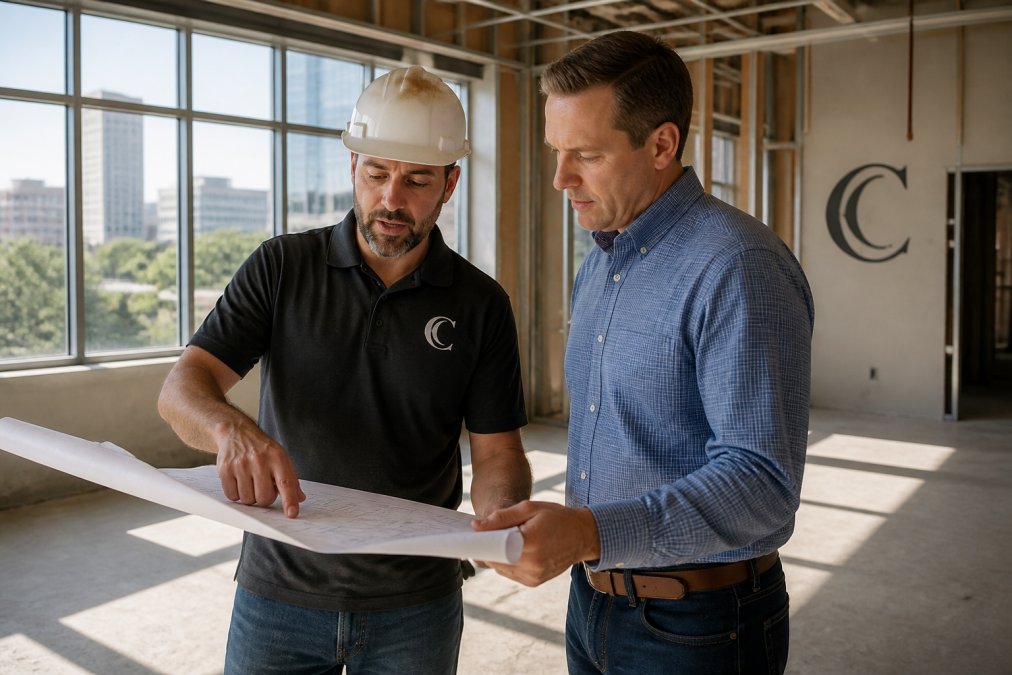
Tenant improvement project management takes a commercial space from design concept through construction to final inspection and occupancy, with one accountable party managing scope, budget, schedule, and subcontractors. Done well, the business owner stays focused on operations while the build progresses on a predictable timeline. Complex interior fit-outs often require specialized technical expertise, making the process of hiring commercial electrical contractors a critical component of maintaining both safety standards and project momentum.
Pre-Construction Planning and Design-Build Advantages
Pre-construction planning is where budget and schedule are won or lost. The contractor reviews drawings, walks the site, identifies conflicts, and produces a realistic budget and timeline before a single wall is framed. The design-build model combines design and construction under one contract, removing the finger-pointing when an architect and contractor disagree about who owns a problem. With a single point of accountability, changes get priced and approved faster, and the owner has one number to call.
Crosspoint Contracting uses this design-build approach on tenant improvements and build-outs, and we send real-time project updates through Projul so clients are not left guessing about progress. As one client put it after a commercial build-out, “Cliff swooped in like a knight in shining armor saving me from certain, inevitable disaster on my commercial build-out.”
The single biggest predictor of a smooth commercial project is not the lowest bid. It is whether one accountable party owns design, budget, schedule, and subcontractor management from start to finish.
Sustainability and LEED Certification in Commercial Construction
LEED certification is a third-party rating system for green building that can lower long-term operating costs through energy and water efficiency. Common sustainability measures include high-efficiency HVAC systems, LED lighting, low-flow plumbing fixtures, and recycled or regionally sourced materials. Certification is optional, but many jurisdictions offer expedited permitting or tax incentives for green building, and some tenants specifically seek out certified spaces.
The practical question is whether certification fits your project’s budget and timeline. For a tenant improvement, targeting a lower certification level is often achievable without major cost increases. For ground-up construction, the decisions that matter most, orientation, envelope, and mechanical systems, are made early, so sustainability goals need to be set during pre-construction, not after.
U.S. Green Building Council LEED rating system overview
Conclusion
Hiring the wrong commercial contractor costs more than money; it costs time, momentum, and the trust of your tenants or customers. Crosspoint Contracting has worked across the Phoenix Valley for 16 years, is ROC-licensed for both residential and commercial work, and keeps projects accountable through a design-build approach, real-time updates via Projul, and same-day communication with a single point of contact. Get a free quote from Crosspoint Contracting and start your commercial project with a contractor who stays accountable from first walkthrough to final inspection.
Frequently Asked Questions
What should I look for when hiring commercial general contractors?
Verify the contractor holds a current commercial license and carries general liability insurance and bonding. Ask for their license number and check it through your state’s contractor board. Look for a portfolio of similar projects, references from recent clients, and a clear communication plan. A qualified commercial general contractor will provide a detailed scope of work, transparent pricing, and a realistic timeline before you sign anything.
How do commercial general contractors charge for tenant improvements?
Pricing depends on the scope of work, materials, and labor involved. Ask the contractor about their pricing model and how they handle change orders.
How do I verify a commercial contractor’s license and insurance?
Every state maintains a contractor licensing board where you can look up a license number and confirm it is active and in good standing. Request a certificate of insurance directly from the contractor’s insurer, not just a photocopy. Confirm general liability coverage limits and workers’ compensation. If the contractor is bonded, ask for the bond number and verify it with the surety company. Crosspoint Contracting holds Residential ROC 263190 and Commercial ROC 283814 for reference.
What is the difference between a general contractor and a commercial contractor?
A general contractor manages residential projects like home remodels and additions. A commercial contractor specializes in non-residential buildings such as retail spaces, offices, medical facilities, and restaurants. Commercial work involves stricter building codes, ADA compliance, and larger subcontractor coordination. Some contractors hold both residential and commercial licenses, which lets them handle mixed-use or tenant improvement projects without bringing in a second firm.