


Table of Contents
- ADU Rental Income Potential in Phoenix: 2026 Market Snapshot
- Phoenix ADU Zoning Requirements 2026: What Changed and What It Means for Your Build
- Short-Term Rental Registry Compliance: The April 2026 Deadline Every ADU Owner Needs to Know
- Cost to Build an ADU in the Valley: Where Your Money Actually Goes
- Short-Term vs. Long-Term Rental Strategies for Phoenix ADUs
- Financing Your ADU: House Hacking, HELOCs, and ADU-Specific Products
- Operational Expenses, Resale Value, and the Full ROI Picture
- Conclusion: Is an ADU Rental Worth Building in Phoenix?
- Frequently Asked Questions
Last Updated: October 1, 2026
ADU Rental Income Potential in Phoenix: 2026 Market Snapshot
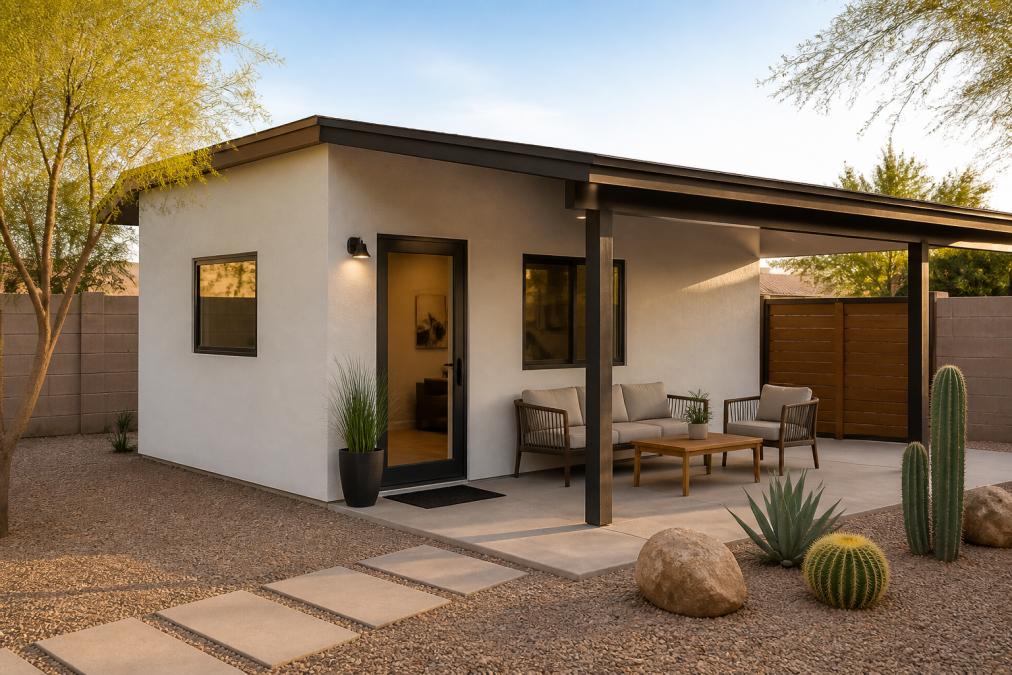
An accessory dwelling unit is a secondary residence built on the same lot as a primary home, and in Phoenix it has become one of the most discussed paths to adu rental income. This guide breaks down the 2026 numbers, zoning rules, and where the real money goes: demand is strong, but the margin lives in compliance and construction discipline.
What the Numbers Look Like Right Now
- A one-bedroom detached unit generally commands a higher monthly rate than a converted garage
- Two-bedroom layouts widen your tenant pool but cost more to build
- Furnished short-term units can earn more per night but carry higher turnover costs
The single biggest driver of adu rental income is not the nightly rate. It is occupancy, and occupancy is a function of location, finish quality, and compliance. A legal, well-built unit stays booked. An unpermitted one gets shut down.
Why 2026 Is Different From Previous Years
Three things changed: the city tightened short-term rental registry rules, construction costs stabilized, and more lenders offer ADU-specific financing. The market now rewards prepared owners, lock your zoning, permits, and budget before you break ground.
Phoenix ADU Zoning Requirements 2026: What Changed and What It Means for Your Build
Phoenix ADU zoning requirements 2026 center on lot size, setbacks, height limits, and parking. The city allows ADUs in most residential zoning districts, but each property must meet specific standards before you can pull a permit.
The practical checklist looks like this:
- Confirm your lot meets the minimum size for an ADU
- Verify rear and side zoning setbacks for a detached build
- Check the height limit, which affects whether you can go two stories
- Confirm parking requirements, which vary by district
- Submit for plan review before any construction starts
The most expensive mistake we see is building first and asking about zoning second. If your structure violates a setback or height limit, you may be forced to demolish or relocate it, and no rental income will cover that loss.
Short-Term Rental Registry Compliance: The April 2026 Deadline Every ADU Owner Needs to Know
Short-term rental registry compliance is now a legal requirement, not a formality, and for ADU owners it is the single fastest way to lose a year of income. Arizona preempts most local bans on short-term rentals through Arizona Revised Statutes Title 9, Chapter 4, Article 8 (A.R.S. § 9-500.39), which means the city cannot prohibit you from operating, but it can require you to register, and it can fine you for operating out of compliance.
What the April 2026 Deadline Actually Changes
Previously, an owner could list a unit and register after the fact with little consequence. Now registration must be in place before the first night is booked, and the city cross-checks active listings against the registry. An unregistered unit is unlicensed, and platforms must remove listings that cannot produce a valid registration number on request.
The Compliance Checklist
Work through this in order. Each item is a gate; close it before moving on.
- Confirm the ADU is a legal dwelling unit. You cannot register a short-term rental in a structure that failed to pull permits or does not meet ADU zoning standards. Registration and zoning are separate approvals.
- Obtain the city registration for the specific unit. Registration is per-unit, not per-owner. If you build a second ADU later, it needs its own registration.
- Display the registration number on every listing. The number must appear in the listing itself, not buried in a house manual. Platforms verify this.
- Carry liability insurance that names the rental use. A standard homeowner’s policy typically excludes commercial rental activity; a dedicated short-term rental endorsement or commercial policy is required.
- Designate a local contact who can respond in person. The contact must be reachable and able to be on-site within a reasonable window for noise, safety, or code complaints. An out-of-state owner with a property manager satisfies this; one with no local contact does not.
- Register for and remit transaction privilege tax (TPT). Arizona taxes short-term rentals under the transient lodging classification. Review Arizona Department of Revenue transaction privilege tax guidance and confirm whether the city also imposes a local TPT on transient lodging, because the combined rate is what you actually owe.
- Post health, safety, and noise rules inside the unit. Smoke and carbon monoxide detectors, fire extinguisher, occupancy limit, and quiet hours. This is a documentation requirement, not just good practice.
- Renew on schedule. Registration is not permanent. Calendar the renewal date the day you receive the certificate.
Failing to register can trigger civil penalties and, in serious or repeat cases, an order to stop operating entirely. The penalty is not just the fine, it is the lost bookings during the shutdown and the platform delisting that follows. For an ADU that was underwritten on short-term revenue, a shutdown can flip a positive cash-flow property negative for the year.
The Strategic Takeaway
Compliance is not overhead, it is the moat. Owners who register correctly stay listed, insurable, and command a resale premium; those who treat the registry as a formality get delisted mid-season. Build compliance cost into your pro forma from day one.
Cost to Build an ADU in the Valley: Where Your Money Actually Goes
The cost to build an ADU in the Valley depends on size, attached versus detached, and finish level. A converted garage costs far less than a detached two-bedroom with a full kitchen and bath.
Here is where the budget actually goes:
| Cost Category | What It Covers | Why It Varies |
|---|---|---|
| Site work | Grading, utilities, foundation | Lot conditions, trenching distance |
| Shell construction | Framing, roof, walls, windows | Size, materials, design complexity |
| Systems | Electrical, plumbing, HVAC | Distance from main house, code upgrades |
| Finishes | Cabinets, flooring, fixtures | Finish level you choose |
| Permits and fees | Plan review, inspections | Scope and jurisdiction |
| Contingency | Unexpected issues | Age of existing home, soil, discovery |
Short-Term vs. Long-Term Rental Strategies for Phoenix ADUs
Choosing between short-term and long-term rentals shapes your adu rental income more than any other decision. Each model has a distinct risk and effort profile.
| Factor | Short-Term Rental | Long-Term Rental |
|---|---|---|
| Income potential | Higher per night, seasonal | Steady, predictable |
| Effort | High: cleaning, turnover, guest issues | Low: mostly hands-off |
| Regulation | Registry and tax compliance required | Standard landlord rules |
| Vacancy risk | Seasonal swings | Lower, longer leases |
| Furnishing | Fully furnished required | Optional |
If you are unsure which model fits, design the unit so it can switch. A layout with a lockable interior door, separate climate control, and durable finishes converts from long-term to short-term without a remodel.
Financing Your ADU: House Hacking, HELOCs, and ADU-Specific Products
House hacking, which means living in one unit and renting another, remains the most accessible way to fund an ADU because rental income offsets the mortgage. Beyond that, three financing routes dominate.
- HELOC: Uses your home equity, often with competitive rates, but your home secures the debt
- Cash-out refinance: Replaces your mortgage with a larger one, useful if rates favor it
- ADU-specific loans: Newer products designed around projected rental income, with stricter underwriting
Operational Expenses, Resale Value, and the Full ROI Picture
Gross rent sells a build; net operating income pays for it. Most ADU content stops at the gross figure, which is why so many owners are surprised in year two. Here is the full picture, expense by expense.
The Operating Expense Stack
Beyond the mortgage, an ADU carries a distinct expense profile. Budget for each of these:
- Property tax reassessment. The county reassesses after completion, adding the ADU’s assessed value to the tax roll. Expect the annual tax bill to rise in proportion to added value, not added rent.
- Insurance. A second dwelling changes the risk profile. Landlord policies, short-term rental endorsements, or commercial coverage cost more than a standard homeowner’s policy, and the premium scales with rental use, not just square footage.
- Maintenance and repairs. A common planning figure is 1% of replacement cost per year, plus a separate capital reserve for roof, HVAC, and appliances. Short-term rentals accelerate wear on finishes and furnishings.
- Turnover and cleaning. For short-term units, cleaning, laundry, and restocking are per-stay costs, not monthly ones. A unit booked 15 nights a month can carry more cleaning cost than a long-term unit carries in a year.
- Property management. Self-managed long-term rentals run near zero; full-service short-term management takes a meaningful percentage of gross revenue. Decide which model you are underwriting before running numbers.
- Utilities. If utilities are included in rent, common for short-term and some long-term units, they are an operating expense, not a tenant cost. Separate metering avoids this and is worth designing in from the start.
- Vacancy allowance. Even a strong unit sits empty between tenants. Underwrite a vacancy allowance rather than assuming 100% occupancy.
A Worked NOI Framework
You do not need a spreadsheet to see the shape of the deal. Build it in four lines:
- Gross scheduled income, monthly rent × 12.
- Less vacancy and credit loss, apply your vacancy allowance to gross scheduled income.
- Less operating expenses, sum every line above except the mortgage.
- Equals net operating income (NOI).
Underwrite to NOI, then stress-test it. If the deal only works at full occupancy, full nightly rate, and zero maintenance, it does not work. Run the same numbers at a lower occupancy and a higher expense load and see whether cash flow stays positive. That is the version of the deal you should be willing to build.
Resale Value: The Quiet Upside
Do not skip the permit to save money. Unpermitted ADUs surface during appraisal and inspection, and they can stall a sale or force a price reduction that dwarfs whatever you saved. The permit is not a cost, it is the thing that makes the asset financeable.
Crosspoint Contracting has built additions and whole-home remodels through multiple market cycles. We are ROC-licensed for both residential and commercial work.
Conclusion: Is an ADU Rental Worth Building in Phoenix?
An ADU pays off when it is built legally, financed sensibly, and matched to the right rental strategy. Skip any of those three and the numbers get ugly fast. Get them right and you have a genuine second income stream and a more valuable property.
Frequently Asked Questions
How does the short-term rental registry impact ADU income potential in Phoenix?
The April 2026 registry changes require all short-term rental operators to register with the city, pay fees, and comply with occupancy and noise rules. For ADU owners, this means budgeting for compliance costs and potentially limiting rental nights. However, registered properties often see higher demand because guests trust licensed operators. Factor registration fees and any occupancy caps into your rental yield projections before committing to a short-term rental strategy.
What are the current ADU zoning requirements in the area for 2026?
Phoenix allows ADUs on properties zoned for single-family residential use, subject to setback rules, height limits, and parking requirements. In 2026, the city continues to update its zoning code to align with state affordable housing mandates. Key items to verify for your lot include minimum rear and side setbacks, maximum square footage, and whether your property falls within a historic district. Always pull the latest zoning verification letter before designing your ADU.
What is the average ROI for a detached ADU in the current market?
ROI varies widely based on construction cost, rental strategy, and financing. A detached ADU with a long-term tenant typically generates steady monthly cash flow, while short-term rentals can produce higher gross income but come with higher operating expenses and vacancy risk. To estimate your ROI, subtract total annual operating costs from gross rental income, then divide by your total project cost. Aim for a net operating income that covers your financing costs with room to spare.
Does adding an ADU increase property tax significantly?
Yes, adding an ADU typically increases your property tax assessment because the taxable value of your property rises with the new structure. The increase depends on your county assessor’s valuation of the ADU and local tax rates. Budget for this higher assessment in your first year of operation. Some homeowners offset the increase by generating rental income that exceeds the additional tax burden, but you should model both scenarios before building.
How do I calculate potential rental income for a backyard cottage?
Start by researching comparable rentals in your neighborhood, including both long-term and short-term listings. Estimate your occupancy rate based on local demand and seasonality. Multiply the nightly or monthly rate by your expected occupancy to get gross rental income. Then subtract operating expenses like utilities, cleaning, maintenance, and platform fees. The result is your net operating income. Use that figure to evaluate whether the ADU meets your cash flow and ROI targets.